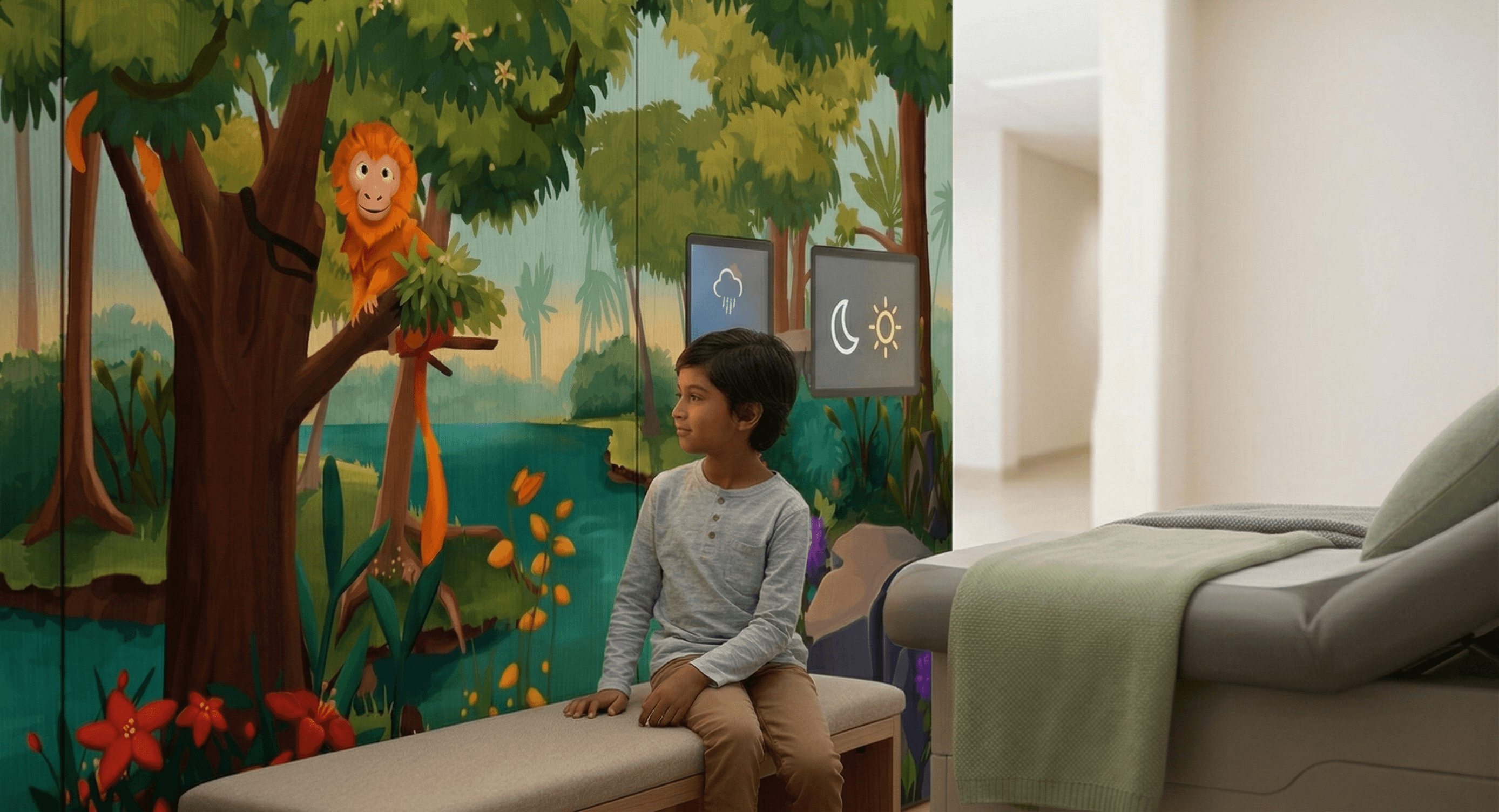
The Role of First Impressions
Decoration shapes first impressions. It communicates identity and atmosphere, and it can soften the initial experience of entering a clinical
environment. What it does not automatically do is guide attention once a child is inside the room and beginning to interpret what is about to happen.
It is in those minutes before hands-on care begins that the distinction becomes most visible.
Searching for Cues
As attention narrows, a child is no longer scanning the room for charm. They are searching for cues:
What will happen next? Where should I look? What do I do with my body? If the environment offers no structure in that moment, clinicians are left to carry the
responsibility of calming and orienting the child through words alone while the space itself remains passive.
Statement vs Anticipation
This is not a criticism of murals or themed rooms. They serve a meaningful purpose. But they were never intended to provide structure during the in-visit experience.
Expecting them to do so reveals a gap in how we think about pediatric design.
Decoration makes a statement; design anticipates use.
When we stop at decoration, we improve atmosphere but leave the Middle Moment unsupported. A room may feel welcoming on entry yet offer little reinforcement once attention begins to narrow.
A more mature design lens therefore asks a different question — not simply whether the space feels friendly, but how it functions in the minutes before engagement with clinicians.
Performance Over Appearance
That shift moves us from thinking about how a room appears to thinking about how it performs. It asks whether the environment participates in care or simply frames it. The distinction may not
be obvious at first glance, but it becomes unmistakable when a child is trying to make sense of what is about to happen.
The Philosophy of Intentionality
This is the philosophy behind solutions like StoryWall and Breathe With Me —
not decoration layered onto a room, but structure integrated into the experience itself.
Pediatric environments have already evolved once, moving from sterile to warm. The next evolution may be quieter but deeper: from decorative to intentional.
Decoration signaled that children matter. Design ensures the space supports them when it matters most.
Learn More
👉 Discover why AR makes Cosmos uniquely suited for hospitals,
clinics, and therapy spaces.