Defining "The Middle Moment"
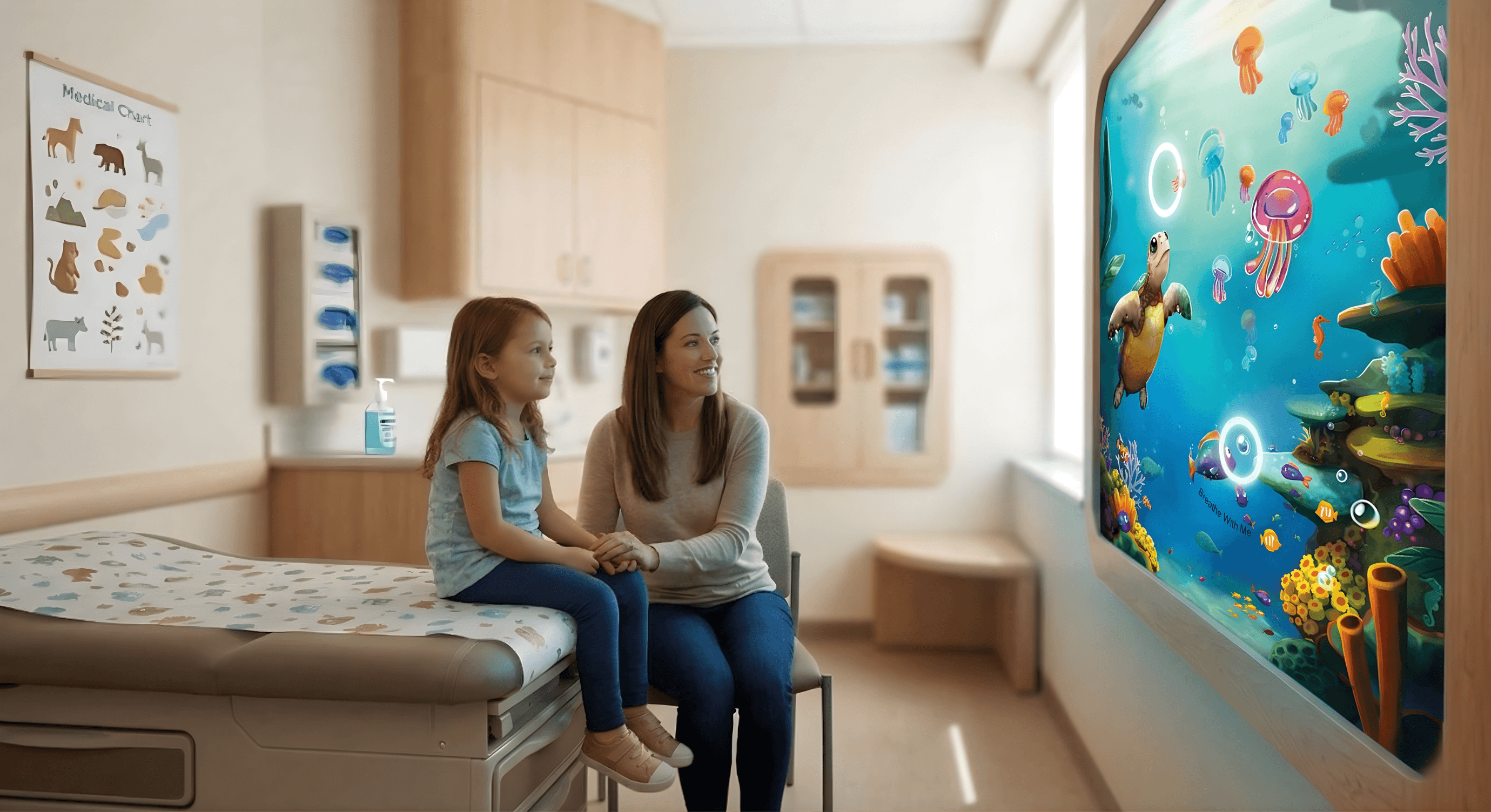
That in-visit space, the time before hands-on care begins, is what we refer to as The Middle Moment.
It is not dramatic. It is not a single emotional spike. It is the lived experience inside the pediatric environment — the
period when children begin taking in cues, forming impressions, and trying to make sense of what is about to happen. This phase
is predictable. And when something is predictable, it can be designed for.
Beyond Aesthetics: From Decor to Structure”
Pediatric rooms today are brighter and more welcoming than they once were. Murals and themed décor signal care and consideration.
That matters. But décor does not necessarily provide structure once a child is inside the space.
When attention begins to narrow, children do not process their surroundings randomly. They look for something steady or predictable
that helps them understand the moment. If the room offers no clear focal point, attention settles wherever it can — often on equipment, movement, or fragments of conversation.
Strategies for Intentional Design
Designing for the Middle Moment means recognizing that the environment can do more than sit in the background. It can provide structure before a procedure begins. It can offer a focal anchor.
It can create opportunities for participation rather than positioning the child as a passive observer.
These shifts do not require spectacle. A calm visual progression can give attention somewhere to rest — an approach reflected in solutions like StoryWall. A visible breathing cue can make a
simple instruction easier to follow, as demonstrated in Breathe With Me. When a child can track something predictable or synchronize with a shared rhythm, the experience becomes more collaborative.
Distraction vs Engagement
Nothing about the procedure changes. But the tone of the room does.
This is the difference between distraction and engagement. Distraction pulls attention away from what is happening. Engagement provides a structured path through what is happening. One attempts to
avoid the moment; the other supports it.
The Environment as a Caregiver
When the environment aligns with what caregivers are trying to accomplish — steady explanation, calm presence, reassurance — the burden does not rest entirely on human interaction. The space reinforces the tone of care.
If the time before a procedure is predictable, it deserves thoughtful design. The room is not simply where care happens. It can become part of how care is delivered.
Learn More
👉 Discover why AR makes Cosmos uniquely suited for hospitals,
clinics, and therapy spaces.