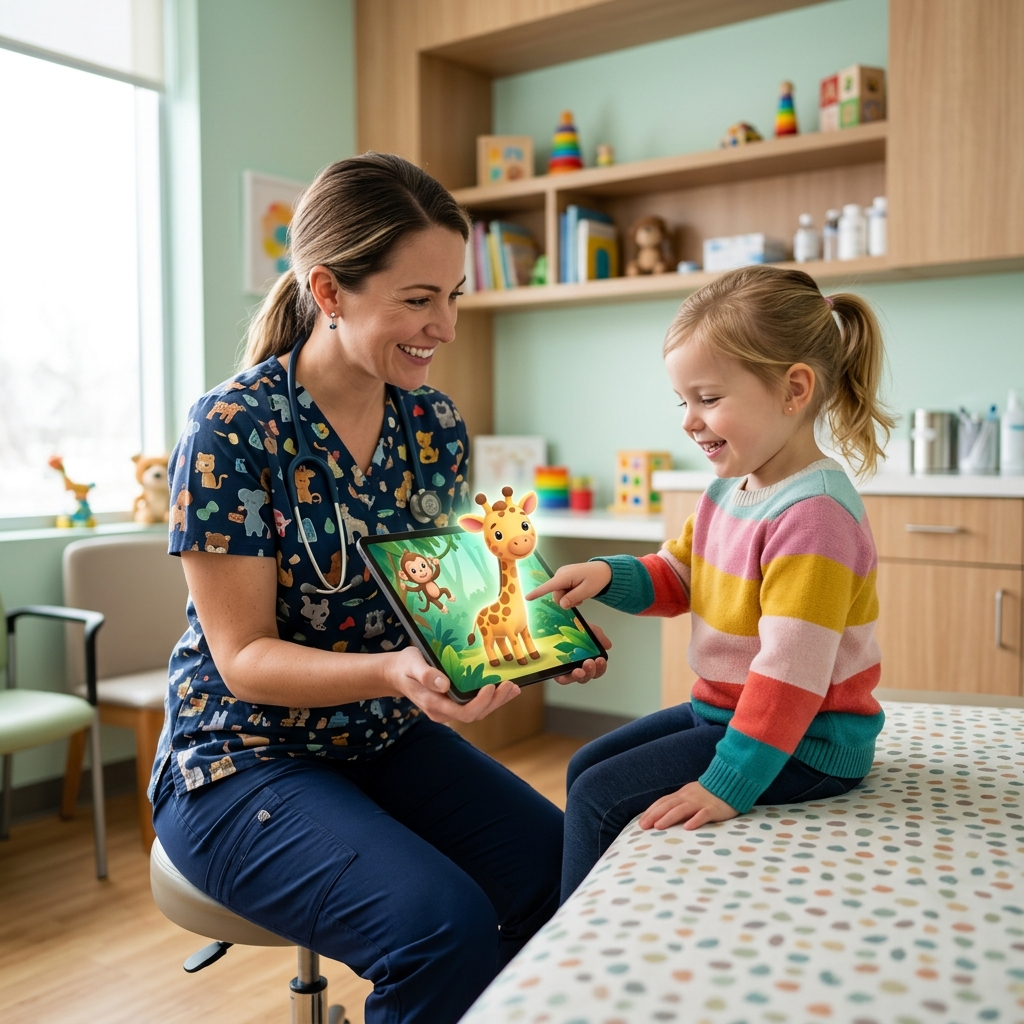
There is a design assumption built into most clinical spaces that goes largely unexamined. It is not written in any policy document. It is rarely discussed in planning meetings. But it shapes almost every pediatric room in almost every pediatric facility in the country.
The assumption is this: the room is neutral.
The room holds the equipment. It contains the encounter. It frames the work that clinicians do. But the room itself — the walls, the light, the scale of things, the objects that fill the space — is understood to be passive. Background. Separate from the care being delivered inside it.
That assumption is incomplete. And understanding why it is incomplete is the beginning of something important.
What the Room Is Actually Doing
Walk into any room where a child has just been placed and ask yourself: what is this room communicating right now?
Not what it intends to communicate. What it is actually communicating, to a six-year-old who arrived five minutes ago and is sitting on a paper-covered table, still in their clothes, looking at equipment they cannot name, waiting for something they were not fully able to prepare for.
The room is communicating. Constantly, before anyone speaks, before anyone touches anything. It is communicating through the height of the ceiling and the placement of the lights. Through the objects that are visible on the counter and the ones tucked under the table. Through the sound of other rooms filtering through the wall. Through the temperature and the smell and the particular silence that these spaces carry.
Children process all of this — not analytically, but neurologically. A child does not think: this room suggests that I am in a medical context and should expect a procedure. They read the room through their nervous system. This process is older and faster than thought. Human beings have been scanning unfamiliar environments for signals of safety or threat for as long as we have existed. Adults carry context that helps them interpret what they find. In a clinical setting, they know what the equipment is for. They understand the role of the person in the uniform. They have a framework that moderates the scan. Children don’t have that framework. Their scan runs unmediated. What the room says, the child receives directly. And what it says shapes everything that follows.
This is not a marginal phenomenon. It is the foundational dynamic of every pediatric encounter. The room participates in the child’s experience from the moment they enter it. The question has never been whether the room participates. The question is how.
Accidental Participation
Most pediatric rooms participate accidentally.
They were designed for function — which they do well. Equipment is accessible. Surfaces are washable. Lighting is adequate. The layout makes the clinician’s work possible. These are legitimate and important design priorities.
But the child’s experience and their nervous system are not always part of the design conversation. The way a room looks from three feet off the ground — the vantage point of a five-year-old — was not part of the planning conversation.
The result is a room that participates on default settings. It communicates what these rooms have always communicated: that this is a place where medical things happen to bodies, that the people here have knowledge and authority the child doesn’t have, that the tools on the counter are for purposes the child cannot quite identify, and that the child’s job is to wait.
That communication produces a predictable response. The child’s nervous system, reading those signals, concludes that nothing in this space is within their control. And a nervous system that concludes it has no control prepares itself accordingly. The body tightens. Cooperation becomes difficult. The resistance that can derail a procedure — the tears, the flinching, the refusal — is not misbehavior. It’s what happens when a room is designed without the child’s emotional experience in mind.
The Moment This Becomes Visible
There is a particular window in every pediatric visit when the room’s participation is most consequential. It happens after the child arrives and before hands-on care begins. After the door closes. Before the clinician acts.
We call this The Middle Moment™.
It is not a pause in the visit. It’s an active interval during which the child’s nervous system scans the environment and makes a decision that shapes everything that follows.
The Middle Moment is predictable. It happens in every pediatric encounter, without exception — in hospital waiting rooms and pre-operative holding areas, in dental chairs and blood draw centers, in exam rooms at urgent care clinics and community health centers. The setting changes. The moment does not.
What changes the outcome of the Middle Moment is not primarily what clinicians say or do. By the time the first word is spoken, the room has already made its contribution. If the room has participated as most rooms participate — by default, by accident, without intention — the nervous system has already begun preparing for a threat. The clinician then inherits that preparation and must spend time and energy managing the results.
If the room has participated deliberately — if it has offered the child something to orient toward, something to engage with, something that communicates there is something here that is yours — the clinician inherits a different room entirely.
The Design Question No One Is Asking
The pediatric care field has made meaningful progress on the human dimensions of the care experience. Child Life programs are embedded in care teams. Parent presence is not just permitted but encouraged. Language has softened. Staff are trained to read a child’s cues and respond with warmth. These changes are real and they matter.
Environmental design has also improved. Rooms are brighter and less stark. Murals appear on walls. Color is used more thoughtfully. Pediatric waiting rooms no longer look like their adult counterparts. These improvements also matter.
But there is a question that the field has not yet asked systematically: not how do we make the room feel friendlier, but how do we make the room actively support the child’s emotional experience of the moment?
Those are different questions. A friendly room reduces harshness. A participating room — one whose participation is intentional, designed, purposeful — can do something more specific. It can give a child something to engage with at the precise moment their nervous system is scanning for something to hold onto. It can convert a moment of passive waiting into a moment of active agency. It can change what the room says before anyone speaks.
This is the concept at the center of this series: The Participating Room. Not a room that looks better, though it may. Not a room that feels warmer, though it might. A room that has been designed to support the child’s emotional experience — to shape what a child feels in the moments before any human intervention begins.
Why This Matters Now
The history of pediatric care is a history of expanding the circle of what care means. It once meant only competence in treating illness and injury. Then it expanded to include parent presence. Then to emotional support. Then to intentional environmental design. Each expansion was preceded by the recognition that something was missing — that what had seemed like a secondary concern was actually central to what the encounter could be.
The participating room is the next expansion. The understanding that the environment shapes a child’s emotional readiness is well-established in research on pediatric procedural anxiety, on the relationship between a child’s sense of control and their physiological stress response, on the long-term consequences of poorly managed fear in healthcare settings. What is new is the recognition that the room itself can be a designed experience — not merely a designed backdrop.
Every room is already participating. The rooms that participate well do so not by accident but by decision — a decision that someone made, at some point, to treat the environment as an asset to the child’s experience rather than a container for it.
That decision is available to any facility. The series that follows examines what it looks like, who it serves, what it costs not to make it, and what becomes possible when it is made.
Learn More
👉 Discover why AR makes Cosmos uniquely suited for hospitals,
clinics, and therapy spaces.