The child-friendly waiting room. The parent allowed to stay in the room. The Child Life Specialist embedded in the care team. Each of these was, at some point, a new idea that a small number of forward-thinking facilities chose to embrace. Then others followed. Then it became expected. Then it became the floor — the minimum that families assumed would be in place when they walked through the door.
That is how standards move. Not through mandate, but through recognition — the moment enough people in enough rooms look at what they have and understand that something is missing. That moment is happening again.
Beyond the Welcoming Room
The shift that defined the last generation of pediatric environment design was from sterile to welcoming. Clinical spaces became brighter, more colorful, less frightening to look at. It was the right first step and it made a genuine difference.
But a welcoming room that gives a child nothing to do is still a room where powerlessness waits. The emotional experience of the child in the minutes before care begins — The Middle Moment — has never been systematically designed for. It has been managed, improvised around, and absorbed by the people in the room. It has never been solved.
Introducing Guided Agency
Solving it is the next step. And the mechanism for solving it already exists.
Guided Agency — the deliberate design of experiences that give a child genuine control at precisely the moment their nervous system needs it most — is not a theoretical framework. It is operational. It is already present in clinical environments across Europe, where augmented reality experiences built around this principle have been running in hospitals, producing documented outcomes, and changing the condition of children and families in the rooms where care happens. The proof is not projected. It is accumulated.
Zero-Friction Integration
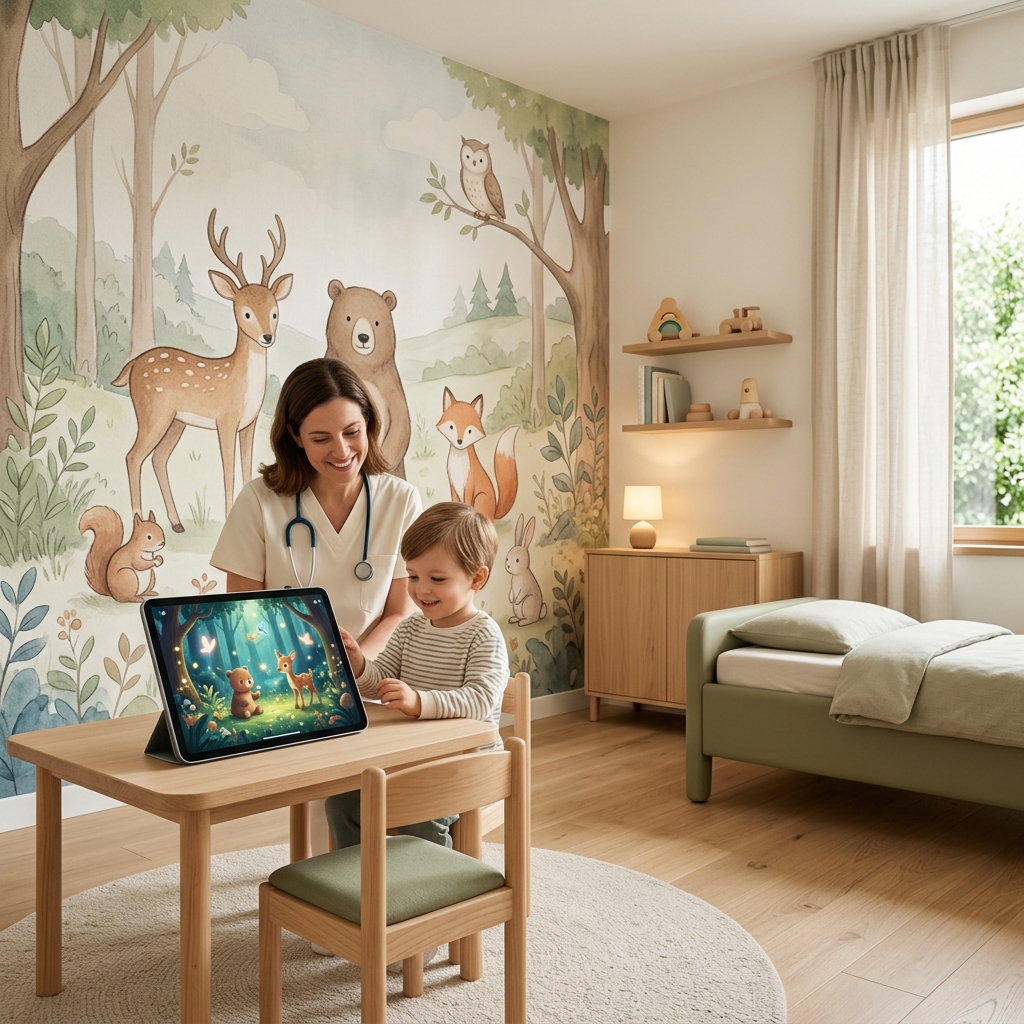
The experience operates independently of the facility's technology infrastructure — no integration, no IT conversation, no dependency on existing systems. A wall mural or a framed image, a mobile device, and a wifi connection that every clinical setting already has. That is the entirety of what the room needs.
Establishing the American Standard
Cosmos Continuum was created specifically to bring this capability to the American market. Not to introduce a concept that is still being tested, but to deliver a proven approach to a market that is ready for it — and that has, until now, had no systematic way to design for The Middle Moment.
Which means the facilities that move first in the US are not taking a risk on an unproven idea. They are establishing the American standard for what a pediatric environment is designed to do. That is a different kind of decision than adoption. It is a positioning decision — one that says this facility understands where pediatric care is going and has chosen to lead rather than follow.
The Baseline of Tomorrow
The history of pediatric care standards suggests that the gap between early adoption and universal expectation is shorter than it appears. The Child Life Specialist was once a novelty. The parent in the room was once a privilege. What feels like the leading edge today has a way of becoming the baseline faster than anyone anticipates.
The Middle Moment has always existed. It has simply never been designed for — until now. The facilities that recognize that first will not just be providing better care. They will be defining what better care looks like.
That is what the next standard feels like from the inside, before it becomes the standard.
Learn More
👉 Discover why AR makes Cosmos uniquely suited for hospitals,
clinics, and therapy spaces.