The Middle Moment: When Biology Takes Over
What follows is familiar to every pediatric nurse, every Child Life Specialist, every clinician who works with children. The resistance. The tears. The rigid body that won't cooperate.
The procedure that should take ten minutes taking forty. This is The Middle Moment not misbehavior, not a meltdown. Biology. A nervous system doing exactly what it was designed to do
when it perceives a loss of control.
And that is the word that matters most: control.
The resistance is not caused by pain. It is often not even caused by fear of what is about to happen. It is caused by powerlessness. The child has no agency in this moment.
Things are happening to them, around them, and they cannot influence any of it. Give the child something they can genuinely control, and the nervous system gets a
different message. I have power here. This moment is not happening entirely without me.
Defining Guided Agency
This is the concept Cosmos calls Guided Agency.
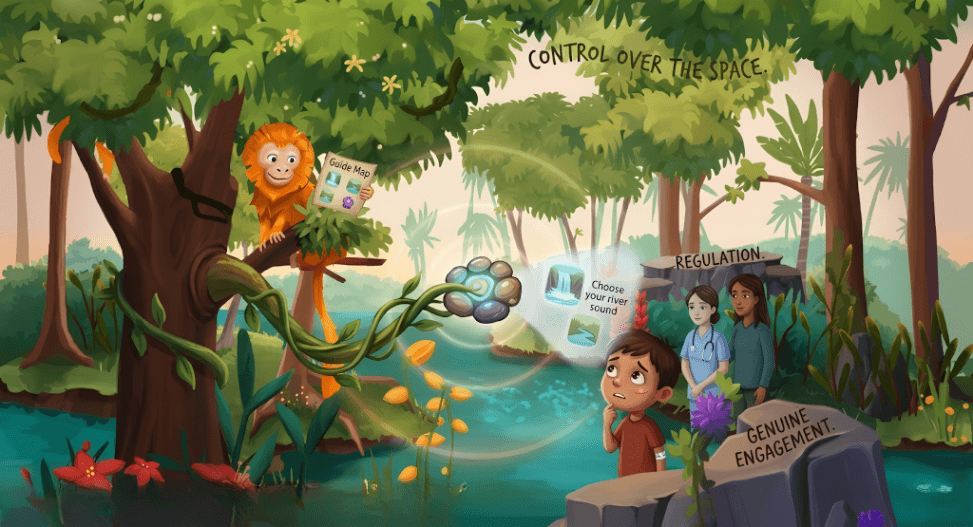
Guided Agency is not a technique a clinician performs on a child. It is not a script or a protocol. It is a designed experience — built into the environment itself — that gives the
child a genuine point of engagement they control, at precisely the moment their nervous system needs it most.
The key word is guided: the experience is structured, purposeful, and designed to work alongside clinical care rather than interrupt it. In a moment where everything else is being done
to them, this one thing they are doing themselves.
Agency vs. Distraction: The Power of Passive vs. Active
The distinction between that and distraction matters more than it might seem.
- Distraction pulls a child's attention away from what is happening. It is passive — the child watches. And it is fragile, the moment attention snaps back, the fear returns, often harder than before.
- Guided Agency works differently. It gives the child something to do inside the moment. A role. A small but real experience of competence and control.
That is not entertainment. That is emotional regulation, and it produces a clinical outcome.
The Ripple Effect of Engagement
When a child is engaged rather than distracted, several things happen simultaneously:
- The child's nervous system receives the signal that this moment is navigable.
- The parent, reading the child, begins to relax.
- The clinician, no longer managing resistance, can focus on care.
The room, which was moments ago a place of rising tension, finds a different equilibrium. That ripple from child to parent to clinician to outcome is what Guided Agency is designed to produce.
The Next Step in Pediatric Design
It has no precedent in traditional pediatric environment design. We have made clinical spaces more colorful, more welcoming, less frightening to look at. That was the right first step.
But a cheerful room that gives a child nothing to do is still a room where powerlessness waits. Guided Agency is the next step the move from a room that looks better to a room that functions
better. A room that actively participates in the emotional experience of the child inside it.
This is not a small idea. Naming it is the beginning of designing for it deliberately, systematically, in every setting where a child sits in that quiet moment before care begins and
their nervous system decides what kind of moment this is going to be.
That decision doesn't have to be left to chance.
Learn More
👉 Discover why AR makes Cosmos uniquely suited for hospitals,
clinics, and therapy spaces.