They know something is about to happen that they did not choose and cannot control, and their nervous system knows it. They scan the room, deciding whether this moment is safe or threatening — something they can navigate, or something that is simply happening to them.
The Middle Moment and the Problem of Powerlessness
This is the same Middle Moment that occurs in every pediatric hospital visit. The same cause — powerlessness — producing the same result — resistance. What changes across settings is the infrastructure around them.
Unfortunately, nothing and no one in this setting is prepared for that moment. So they try to address the child's emotional experience the way they always have: with reassurance, distraction, and the hope that things go quickly.
Resistance does not respect setting. A child who cannot tolerate a needle in a pre-operative holding area and a child who cannot tolerate a needle in an inoculation clinic are having the same experience. The difference is that the hospital has at least acknowledged the problem. In most clinical settings outside the hospital, the problem has not been named, let alone designed for.
Which means the need for Guided Agency may actually be greater there.
Introducing 'Breathe With Me'
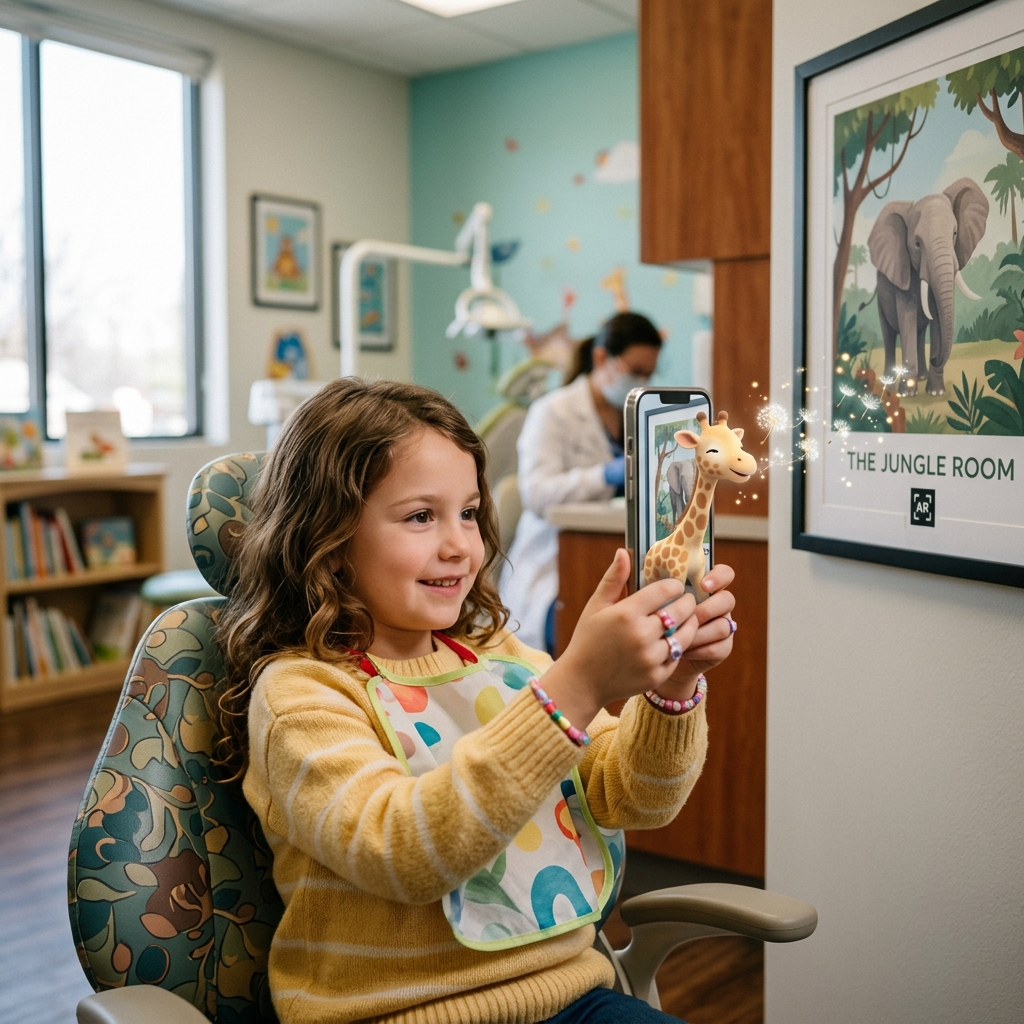
Breathe With Me is ideal for environments like these. It requires nothing from the facility beyond what is already there. No special infrastructure. No servers, no software, no technical integration of any kind. A wifi connection — which every clinical setting already has — is all the technology the room needs to support it. The rest is a framed image on a wall and a mobile device.
A child who points a phone or tablet at that image and watches a giraffe appear — gentle, present, already breathing — has something to follow. The giraffe inhales slowly. The dandelion seeds lift. The giraffe exhales and the seeds drift. The child, without being told, begins to follow the rhythm. Their breath slows. Their shoulders drop. They are doing something — they are in control of their own breath — while the giraffe sets the pace.
Design Doing the Work
No instructions. No pressure. No protocol for the dental assistant to learn or the phlebotomist to manage. The design does the work.
That is Guided Agency in its most portable form. The child still has agency — nobody is controlling their breath for them. But the experience is structured to lead them somewhere specific. Calm is the destination. The giraffe is the guide. And the setting, which moments ago had nothing to offer the child's nervous system, now has something it can orient toward.
Small Enough to Fit the Moment
The Middle Moment happens everywhere a child sits in a clinical chair. For a long time, the environments least equipped to address it have simply absorbed the consequences — the resistant child, the distressed parent, the procedure that takes longer than it should, the memory the child carries home.
It does not have to work that way. The infrastructure those settings are missing does not need to be complicated. It needs to be designed for the moment — and small enough to fit inside it.
That is what Breathe With Me was built to be.
Learn More
👉 Discover why AR makes Cosmos uniquely suited for hospitals,
clinics, and therapy spaces.