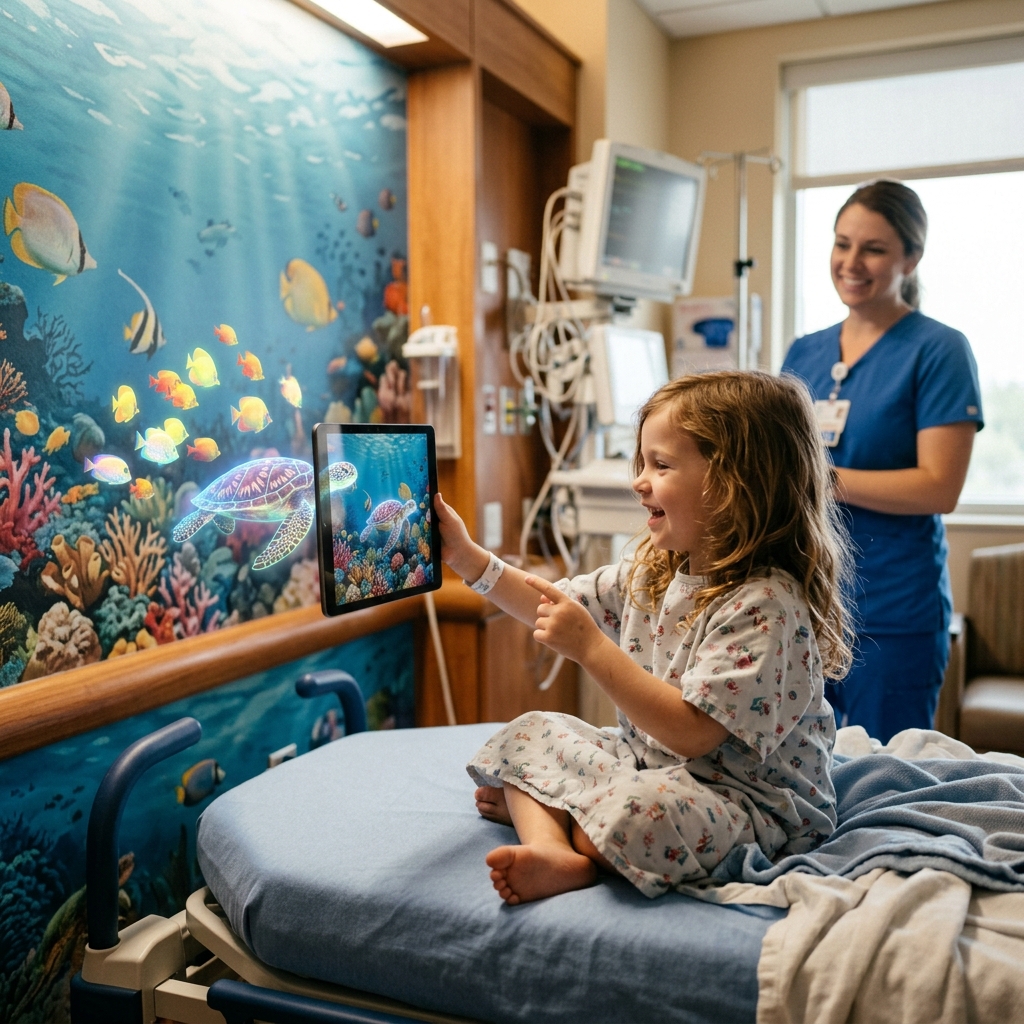
A pediatric nurse has been with them, and a parent is allowed in — one familiar face in a room full of equipment and unfamiliar sounds. The surgeon has come and gone, made a small mark, said something reassuring. In five minutes, they'll come to get you.
The Weight of the Waiting Room
And then there is nothing left to do but wait.
That interval — quiet, unstructured, impossible to fill with explanation — is where the nervous system makes its decision. Whether this is a moment that can be navigated, or one that is simply happening to them. This is The Middle Moment at its most acute. And for a long time, the honest answer to what could be done about it was: not much. You could prepare them. You could stay with them. You could talk to them. However, the room itself had nothing to offer.
Activating the Space through Discovery
But what happens when a child can point a tablet at a wall and watch an underwater world come to life? That's a child with something to do. A child who is exploring, discovering, choosing what comes next — engaged in something that is genuinely theirs to direct. The wall is still a wall. The equipment is still there. The gown hasn't changed. But the child's relationship to the moment has.
That is what Guided Agency looks like in practice. Not a transformation of the clinical environment, but a transformation of what the child can do inside it. At this point, the nervous system receives a different signal. Not "this is happening to me." Something closer to "I have a role here. This moment is not entirely outside my control."
Shift in the Clinical Experience
A surgeon who works in a setting where StoryWall has been in use described watching a child — a girl coming in for yet another procedure — enter the holding area and sit with her mouth open in amazement. She came in laughing. For a clinician who had seen that room go the other way many times, it was, in his words, wonderful.
That is not a small thing. That is the room doing work it could not previously do.
Redefining The Middle Moment
Guided Agency does not require that the clinical moment be softened or disguised. The surgery is still happening. What changes is whether the child arrives at that moment already in free fall, or having spent the last five minutes as someone with agency — someone who was doing something that was genuinely theirs.
The room can produce that. Not by replacing what the clinical team does — but by changing the conditions in which they do it. That is what a room designed for The Middle Moment looks like. And Guided Agency is what makes it more than a design philosophy.
Learn More
👉 Discover why AR makes Cosmos uniquely suited for hospitals,
clinics, and therapy spaces.