The Pediatric Perspective: Beyond System Efficiency
In pediatric care, the most fragile portion of the visit occurs inside the room, in the minutes leading
up to engagement with clinicians. During that time — the in-visit experience we refer to as the Middle Moment —
children are not evaluating system efficiency. They are trying to make sense of what is about to happen.
An intelligent room reacts to inputs. It adjusts lighting, temperature, or sound based on data and programmed thresholds.
These adaptations can improve comfort and workflow. But supporting the Middle Moment is not primarily a matter of calibration.
It is a matter of orientation.
Detection vs. Experience
When a child senses that something unfamiliar is approaching, attention narrows. It begins searching for cues — something steady,
something predictable, something that helps the moment feel navigable. Automatic adjustments may enhance the atmosphere, but they do
not necessarily provide that structure.
Intentional design begins from a different question. Instead of asking what the room can detect, it asks what the child will experience.
It anticipates predictable human responses inside the pediatric space and builds the environment around them. The goal is not simply responsiveness, but alignment.
Innovation with Purpose
For us, this distinction reshaped how we think about innovation in pediatric rooms. Technology can be powerful, but without intentional structure, it risks becoming
another layer of sophistication that leaves the emotional arc of the visit untouched.
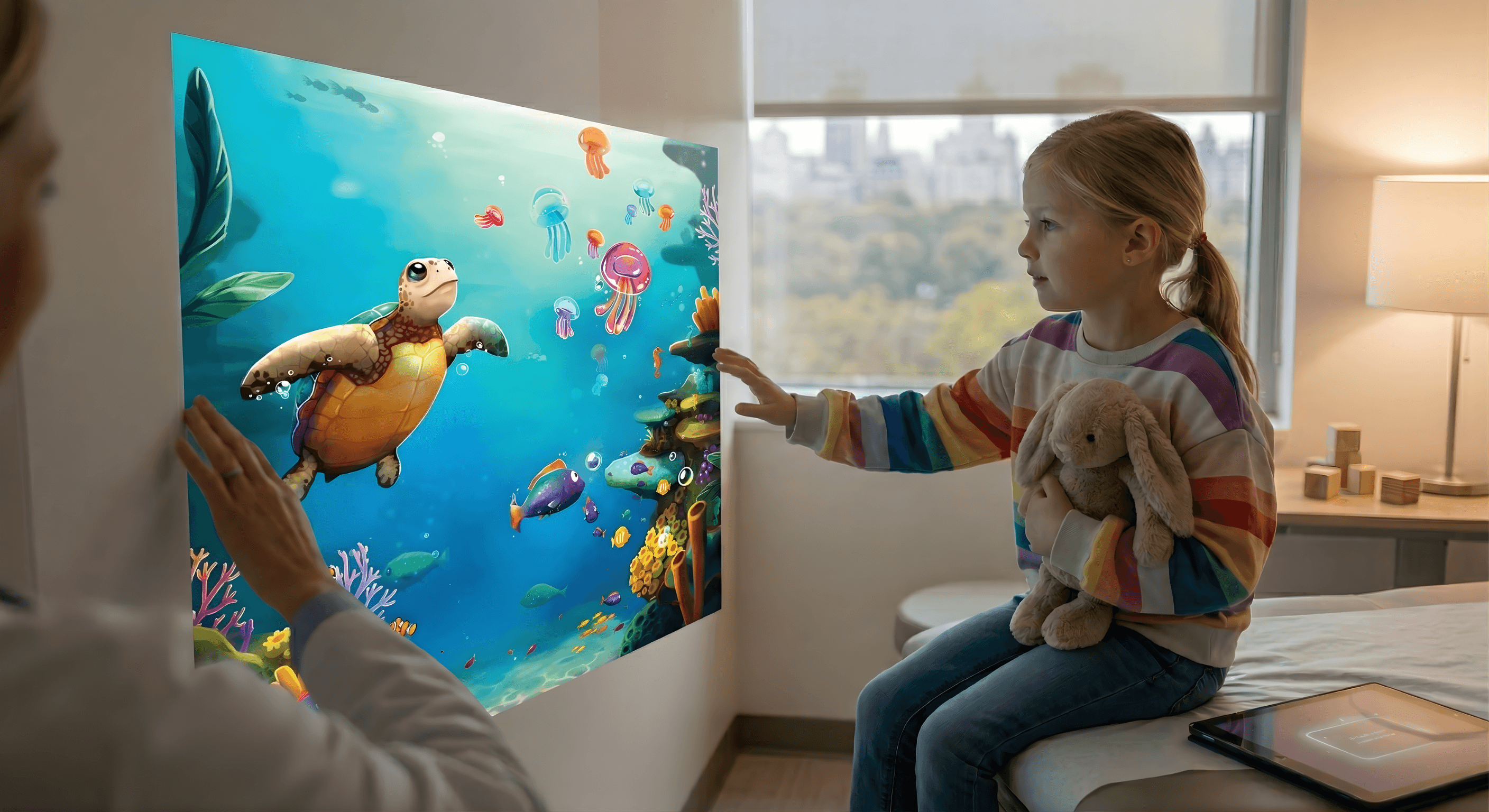
Solutions such as StoryWall and Breathe With Me were developed from this perspective — not as add-ons to make a room more impressive, but as integrated tools that
help guide attention during the Middle Moment.
Anchoring Intelligence in Intentionality
This does not position intelligence and intentionality as opposites. In fact, intelligence is most effective when it is directed by intention. Adaptive systems can
amplify intentional design, but they cannot replace it. Without a guiding philosophy, intelligence optimizes conditions; with one, it supports experience.
As pediatric environments continue to evolve, the conversation should not center solely on how advanced a room becomes. It should also ask what that advancement is serving.
If intelligent features are aligned with predictable human needs inside the space, they strengthen care. If they are layered onto the environment without that alignment, they
remain impressive but emotionally neutral.
The Lasting Impression
An intelligent room can respond quickly. An intentional room prepares deliberately. When intelligence is guided by intentionality, the distinction fades — not because one
replaces the other, but because one is anchored in the other.
In the Middle Moment, that anchoring is what matters. It is not the sophistication of the system that children carry with them. It is whether the environment helped steady
the experience when it mattered most.
Learn More
👉 Discover why AR makes Cosmos uniquely suited for hospitals,
clinics, and therapy spaces.