Beyond the Sterile Aesthetic
Pediatric environments may be approaching such a shift. For years, progress was measured by warmth. Moving from sterile to welcoming was meaningful advancement.
Later, distraction became the dominant strategy for managing the time before procedures. More recently, intelligent systems have promised responsiveness and efficiency.
Each of these developments contributed something valuable. But none of them fully addressed the in-visit experience inside the room the minutes leading up
to engagement with clinicians, when children are forming impressions and trying to understand what comes next.
The Active Environment
Across this series, we have explored that space from multiple angles. The room is not neutral. Decoration is not design. Distraction is not the same as guidance.
Intelligence requires intention. The environment can participate. Emotional architecture can scale.
Taken together, these ideas suggest something larger than a collection of design preferences. They point toward a new standard.
Defining the New Standard
A pediatric room should do more than welcome a child; it should prepare them. It should reinforce steadiness through its structure rather than relying solely
on human reassurance. It should anticipate the Middle Moment as a natural part of the visit rather than treat it as incidental. And it should give the
child something in the environment they can orient to as the experience begins to unfold around them.
When that expectation becomes embedded in planning, renovation, technology adoption, and leadership decisions, pediatric environments begin to function
differently. The room becomes aligned with care delivery rather than adjacent to it.
Intention Over Spectacle
This does not require spectacle. It does not demand constant stimulation or dramatic redesign. It requires clarity about what the space is meant to
support and the discipline to design accordingly.
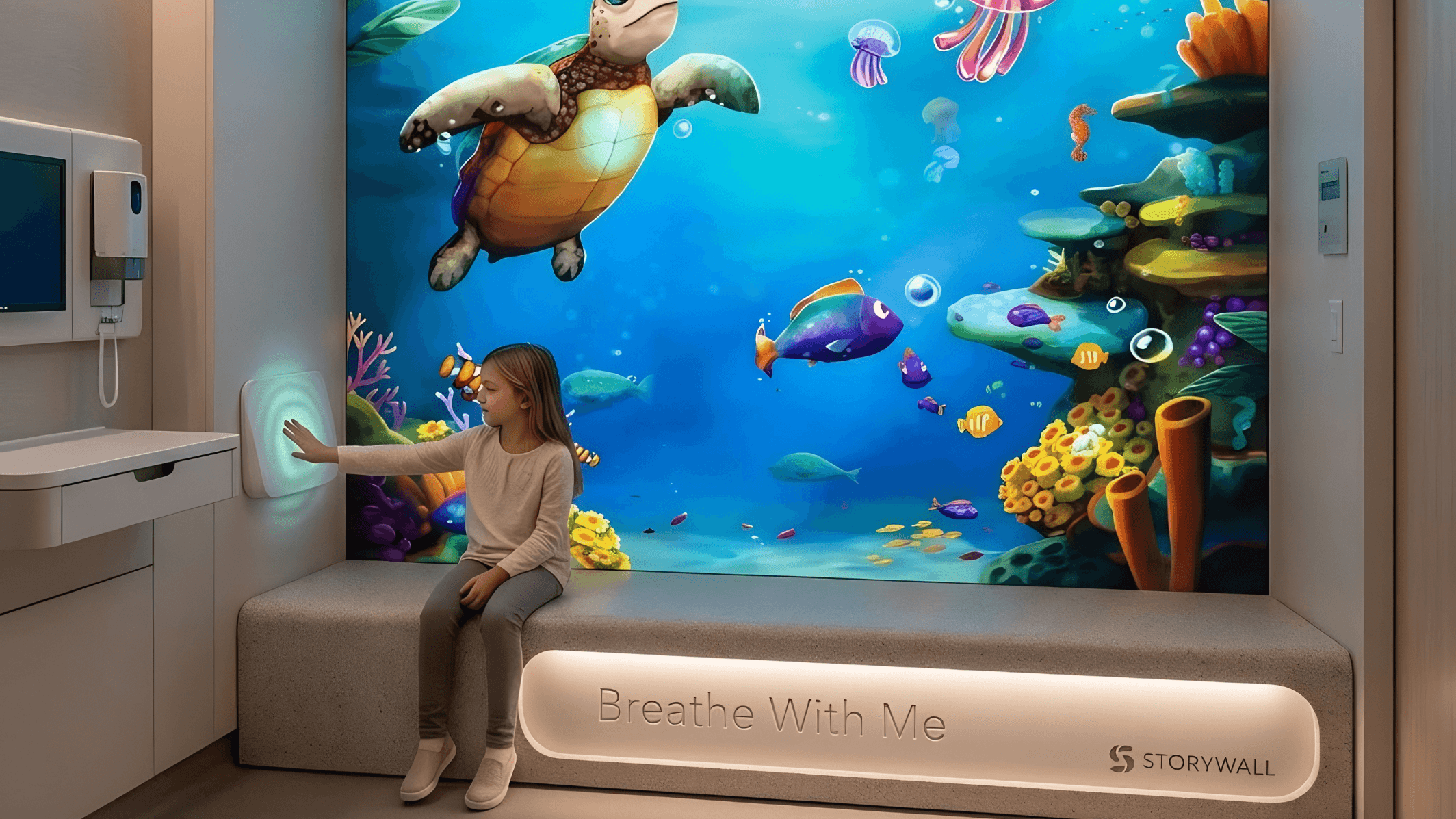
Solutions such as StoryWall and Breathe With Me exist within that framework — not as decorative enhancements or isolated tools, but as expressions
of a broader standard for how pediatric environments can function.
From Innovation to Expectation
Over time, standards reshape perception. What once seemed advanced becomes assumed. What once required explanation becomes expected.
The next standard for pediatric environments may be simple to describe but significant in effect: the room participates in care, intentionally
and consistently, from the moment a child enters.
When that becomes ordinary, the Middle Moment will no longer depend solely on improvisation. It will be supported by design. And that is a
standard worth building toward.
Learn More
👉 Discover why AR makes Cosmos uniquely suited for hospitals,
clinics, and therapy spaces.