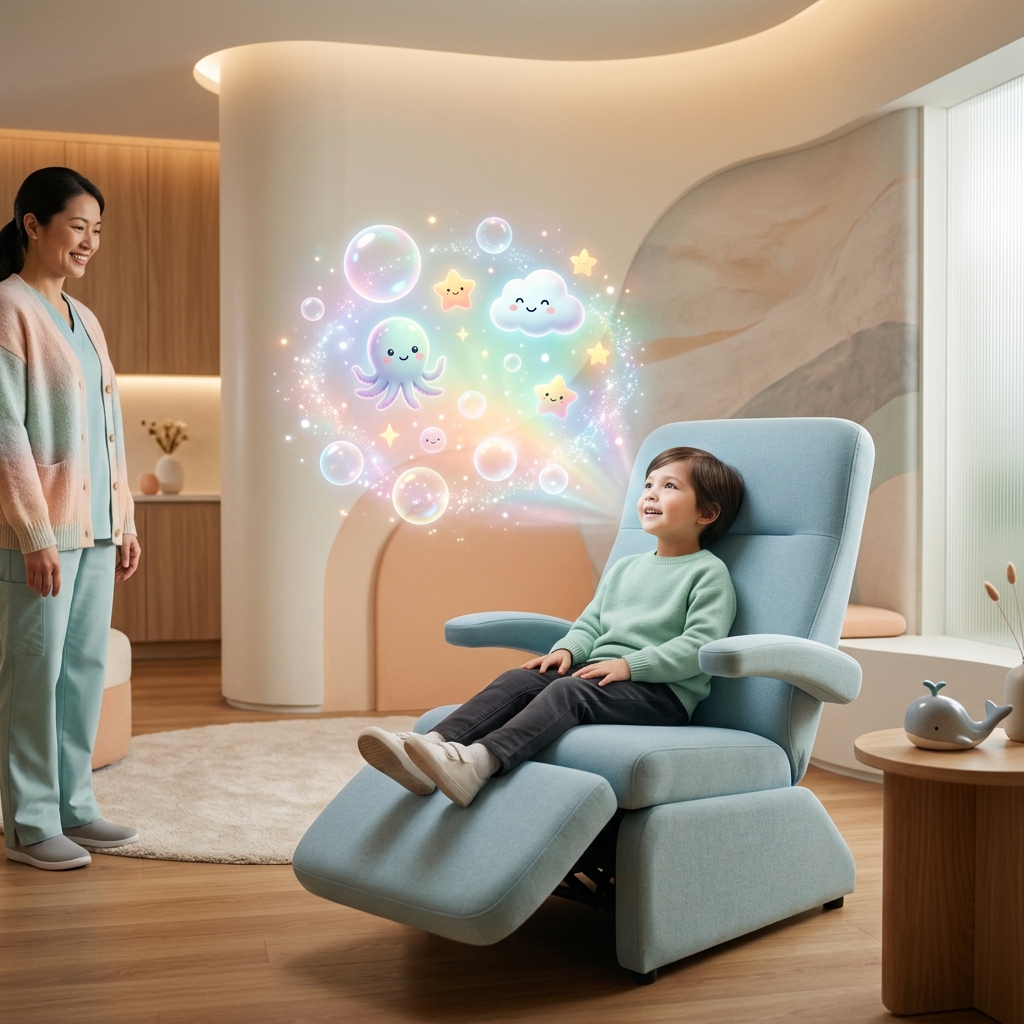
Pediatric care rooms have been designed for a clinical moment. Everything in it — the equipment, the surfaces, the lighting — serves that purpose. They were never designed for what happens before the clinical moment begins.
The Power of "The Middle Moment"
That pre-clinical moment — The Middle Moment — is when a child's nervous system scans the environment and makes a decision that will shape everything that follows. That is the gap The Middle Moment names. And it is the gap Guided Agency was built to close.
When a room is designed for The Middle Moment — when it gives the child something genuine to engage with, something they control, something that orients their nervous system toward curiosity rather than threat — several things happen simultaneously that no single intervention could produce alone.
Shifting the Child's Narrative
The child finds agency in a moment that offered none. Their nervous system receives a different signal. Not "this is happening to me." Something closer to "I am here. I have a role. This moment is not entirely outside my control."
Allowing Parents to Exhale
The parent beside them, reading the child the way parents always do, begins to exhale. The fear they have been holding — the particular fear that belongs only to parents, the one with no professional distance to stand behind — finds somewhere to release. They are still in the room. The procedure is still coming. But the moment feels different, because their child feels different.
Easing the Clinician's Entry
The clinician who walks in finds a room that has already changed. Not because anything clinical has been done — but because the emotional condition of everyone in that room is different from what it would have been. The child is calmer. The parent has exhaled. The first moment of contact is not the management of a crisis but the continuation of a process that has already begun to go well.
The Ripple Effect of Better Care
And the encounter that follows — the procedure, the examination, the care — progresses differently than it could have otherwise. More efficiently. More humanely. With less resistance and more cooperation. With a family that leaves carrying a different memory than the one they feared they would carry.
That ripple — from child to parent to clinician to outcome to memory — is what a room designed for The Middle Moment produces. It does not begin with technology. It begins with the recognition that the room is not a neutral container for clinical work. It is a participant in it. And participation can be designed.
Designing the Future of Pediatrics
Cosmos Continuum exists because that recognition deserves to be acted on — systematically, in every setting where a child sits in a clinical chair and waits for something they didn't choose. The Middle Moment has always been there. The tools to design for it are here now. The only thing that remains is the decision to do so.
Learn More
👉 Discover why AR makes Cosmos uniquely suited for hospitals,
clinics, and therapy spaces.