In the first three posts of this series, we examined the emotional center of pediatric care, the
Middle Moment where fear often takes hold, and the environmental cues that help a child feel safe.
In this fourth post, we explore why certain forms of visual engagement work so
effectively—why they calm the body, soften the emotional temperature of a room, support cooperation,
and help clinicians and parents navigate the most difficult moments of pediatric care.
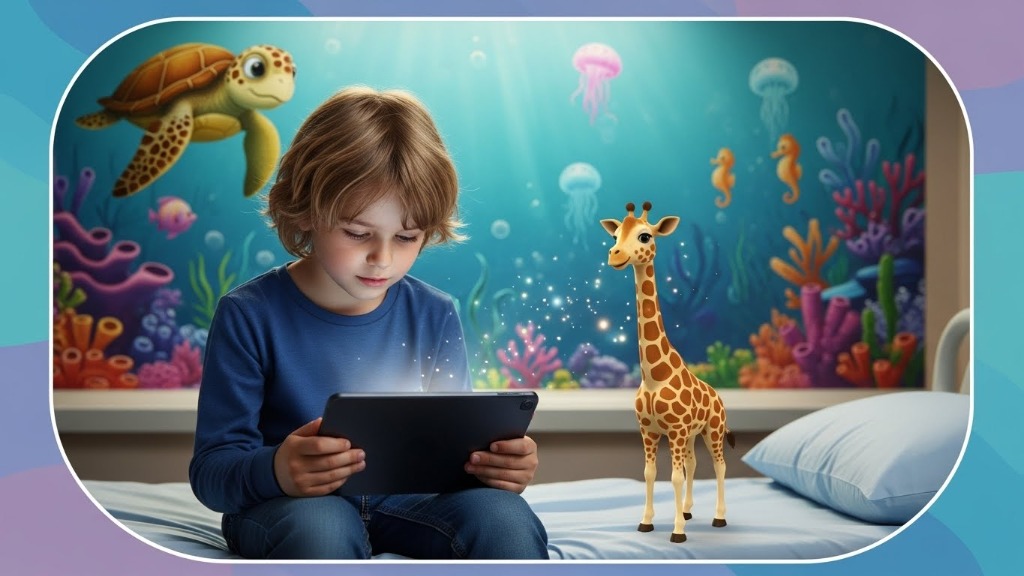
And we look at why Augmented Reality (AR) has emerged as one of the most practical
and powerful tools for this highly sensitive environment.
The Science of How Children Cope With Fear
A child’s fear is not a mindset—it is a physiological event. Their body reacts before their thoughts
can catch up:
- The amygdala signals threat.
- Cortisol and adrenaline rise rapidly.
- Breathing becomes shallow.
- Muscles tighten.
- Attention narrows, sometimes to the point of shutting down the ability to process instructions.
Studies show that higher fear in children correlates with increased anxiety, greater
distress, and behaviors that complicate cooperation and care (Kain et al., 2006).
In this heightened state, even routine care becomes harder. But when a child’s attention can
shift—gently, safely, meaningfully—the entire room shifts with them.
Why Visual Engagement Works
Visual engagement is one of the most reliable ways to redirect fear because of how the brain
prioritizes incoming information.
1. Vision dominates other senses.
Up to 80% of sensory information the brain interprets is visual. When something visually interesting
enters the child’s field of view, it naturally pulls attention away from threat cues (Lidle &
Schmitz, 2022).
2. Curiosity and fear compete for the same mental spotlight.
A child cannot fully process a sense of wonder and a fear response at the same time. Visual or
audiovisual stimuli reliably reduce medical fear and anxiety in children undergoing procedures
(Goktas & Avci, 2023).
3. Visual anchors help regulate the body.
When children fix their gaze on something engaging, their breathing slows, their posture softens,
and their nervous system settles—creating a more cooperative state. Research in pediatric imaging
shows that audiovisual interventions reduce pre-procedure anxiety and support smoother cooperation
(Oktay et al., 2025).
These principles are not psychological tricks. They’re grounded in sensory regulation and
neurobiology.
"When we redirect a child’s attention through visual engagement, we are
doing something profoundly simple and profoundly human: giving their nervous system a place to
rest."
AR, VR, Screens, or Projection Walls?
Not all technologies support emotional regulation equally.
VR (Virtual Reality)
- Requires headsets
- Blocks a child’s view of their parent or clinician
- Can cause dizziness or disorientation
- Requires sanitation protocols
- Often overstimulating for anxious children
- Expensive hardware and replacement cycles
VR is powerful in the right context—but not in moments where a child needs
grounding, connection, and reassurance.
Projection Systems and Immersive Walls
- Require large-scale installation
- Depend on lighting and room configuration
- Break down or require calibration
- Need IT intervention
- Cost hundreds of thousands of dollars
- Risk overstimulation
These systems can entertain. But they are not designed to support emotional regulation
during care.
Passive murals and decoration
Calming, yes. But static enough that a frightened child quickly tunes them out. They cannot hold
attention through fear-driven moments.
Why Augmented Reality (AR) Is Ideal for the Middle Moment
AR blends the real world—the parent, the clinician, the room—with a layer
of gentle engagement that supports a child without overwhelming them.
AR is:
- Familiar (accessed via their phone or tablet)
- Low-friction (no equipment to wear)
- Operationally simple (no calibration, setup, or breakable hardware)
- Emotionally anchoring (keeps the child connected and present)
- Cost-contained (far below projection systems or VR installs)
- Environmentally safe (no sanitation protocol required)
Most importantly: AR redirects a child’s attention without disconnecting them from their caregivers.
This is the critical advantage.
How AR Changes the Room: A Radiating Impact
For the child:
Fear loosens just enough for curiosity to appear. Muscles uncoil. Breathing steadies. Cooperation
becomes possible.
For the parent:
Their child is calmer. Their own anxiety drops. They are no longer carrying the emotional burden
alone.
For the clinician:
A resisting child becomes a reachable child. The task becomes more manageable. Time pressure eases.
Emotional strain reduces. The room becomes workable again.
For the system:
Shorter procedures. Fewer delays. Better throughput. Higher satisfaction. Less cumulative stress on
staff.
This is human-centered innovation at work: Technology used not to dominate the
moment, but to lift it.
The Most Important Insight
AR does not change the medical task. It changes the emotional environment in which the task
occurs—and that changes the entire experience of care.
In the next post, we’ll bring these principles into real-world application with Cosmos
Continuum’s StoryWall and Breathe With Me—two tools designed specifically for the Middle Moment,
where children feel the most and where care depends on calm.
Learn More
👉 Discover why AR makes Cosmos uniquely suited for hospitals,
clinics, and therapy spaces. Visit
our Story Wall page.
Visual Engagement
Augmented Reality
Neuroscience