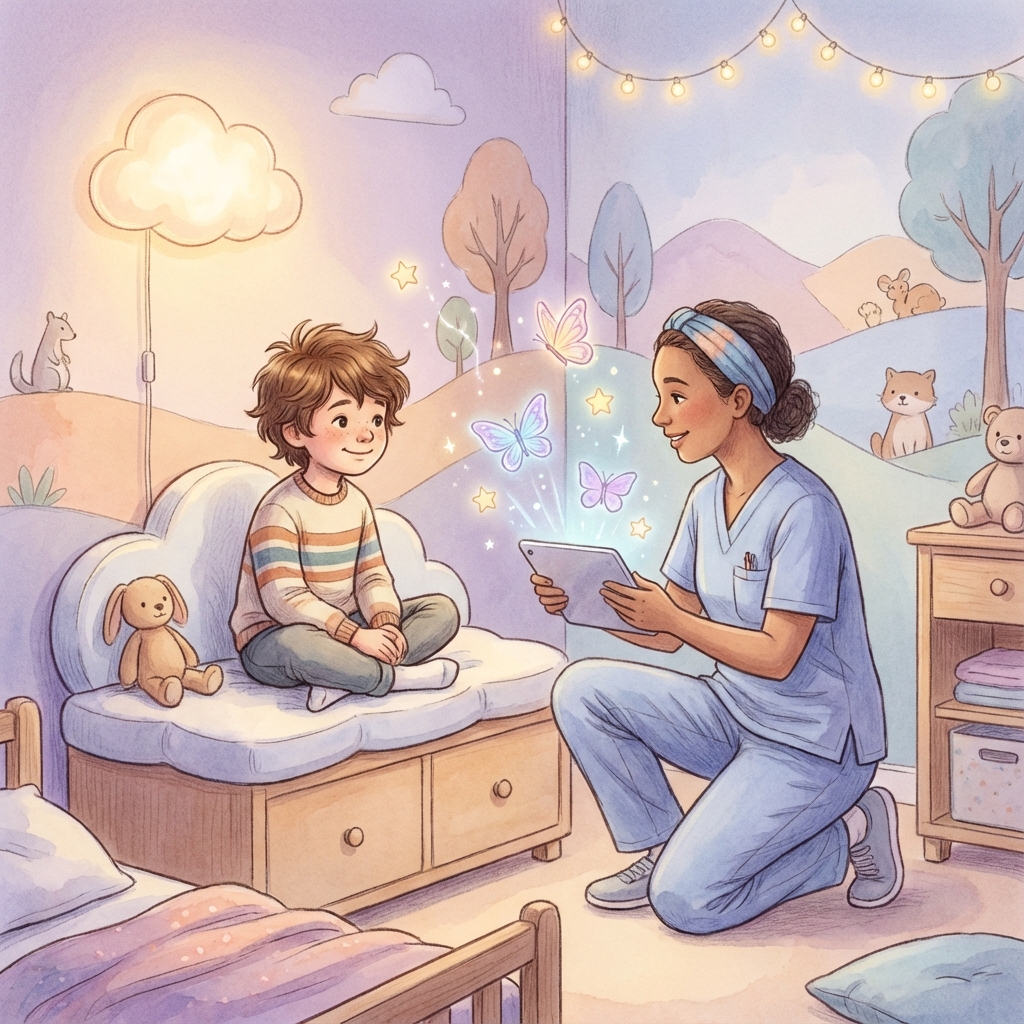
For children, safety isn't an instruction they follow or a concept they understand. It's something
they feel — or don't — the moment they walk into a room.
And while fear in pediatric care is often discussed as a behavioral challenge, it is far more
accurate to understand it as the combined effect of emotion, environment, sensory input, and human
interaction. When these elements support one another, cooperation becomes possible. When they don't,
fear fills the gaps.
This post explores what actually helps a child settle in the Middle Moment — the moment where
healthcare is felt most deeply.
What Children Respond To Emotionally
Children navigate the world through emotional cues, not clinical logic. Before they understand what
is happening, they assess how safe the moment feels.
Several factors shape this assessment:
- Predictability: Children feel safer when they understand what comes next.
Studies show that uncertainty increases physiological stress responses in children.
- Warmth and Tone: A calm voice, a softer pace, and a grounded presence can help
regulate a child's attention.
- Feeling 'Not Alone': A hand nearby, a parent's steady presence, or a clinician
crouching to eye level can anchor their sense of safety.
How Environment Shapes the Stress Response
Environment is not cosmetic in pediatric care. It is part of the therapeutic experience.
A child's senses interpret rooms quickly:
- Harsh lighting can heighten anxiety.
- Blank or clinical walls can make a room feel foreign.
- Visual clutter can overwhelm.
- Unexpected sounds can trigger startle responses.
Conversely, environments with visual softness — gentle imagery, familiar shapes, nature elements,
and warm colors — have been shown to reduce stress responses in children.
One study published in the Journal of Pediatric Nursing found that calming visual stimuli
during procedures led to lower distress behaviors and improved cooperation.
The environment doesn't replace the emotional support of adults — but it amplifies it. A regulated
space helps a child begin to regulate themselves.
The Difference Between Distraction and Engagement
Distraction can divert attention. Engagement can change the emotional trajectory.
Distraction is passive: screens, toys, or noise pull attention away but don't address the fear.
Engagement activates curiosity — shifting the child's emotional state rather than masking it.
Experiential technologies — such as Augmented Reality (AR) — support this shift from fear to
curiosity by giving children something meaningful to explore.
"Curiosity and fear cannot occupy the same mental space with equal
strength. When curiosity rises, fear recedes."
When engagement works, breathing slows. Faces soften. Muscles loosen. Instructions become easier to
follow. The room becomes a safer place to be.
The Role of Parents and Clinicians
Children borrow regulation from the adults around them.
When a child softens:
- Parents release tension.
- Clinicians can focus on the procedure.
- The room shifts toward cooperation.
Research consistently shows that when children calm, parental anxiety decreases — and vice versa.
It is a reinforcing loop — one that begins with the conditions in the environment.
Why Non-Pharmacological Calming Matters
Pharmacological interventions may be necessary but carry risks, costs, delays, and added complexity.
Non-pharmacological supports — emotional, sensory, and relational — offer a low-friction way to help
a child regain control.
Emotional experience today becomes emotional memory tomorrow. A manageable visit
builds confidence; a frightening one builds resistance.
What Helps a Child Feel Safe?
Children feel safe when:
- Their emotions are acknowledged
- Their environment is supportive
- Their senses are grounded
- Their adults are regulated
- Their curiosity is activated
- Their fear has room to ease
These elements work together, not separately.
In the next post, we'll explore how sensory engagement can be designed to support this exact
moment in a child's healthcare journey.
Learn More
👉 Discover why AR makes Cosmos uniquely suited for hospitals,
clinics, and therapy spaces. Visit
our Story Wall page.
Patient Experience
Pediatric Care
Sensory Environment