The appointment that ran so far behind that the next two had to be compressed or rescheduled. The staff member who spent precious time managing fear rather than delivering care. The parent who left with a story they will tell — not about the quality of the clinical work, but about how their child experienced the visit.
In a hospital, these moments can often be absorbed into the operational day. In a dental practice, a blood draw center, or an inoculation clinic, where margins are tighter and schedules have less room to flex, a single difficult encounter can impact the entire day.
This is not a clinical failure. It is a design gap.
The Cost of the "Middle Moment"
The Middle Moment — the interval after a child arrives but before care begins — is the most predictable window in any pediatric clinical encounter. It is the moment when the child's nervous system scans the environment and decides whether what is about to happen feels safe or threatening. That decision shapes everything that follows.
A child who arrives at the clinical moment already calm cooperates more readily, tolerates discomfort more effectively, and moves through the encounter more efficiently. A child who arrives afraid requires management before care can begin — and that management has a cost, in time, in staff resource, and in the experience the family carries home.
What has been missing, across every setting where children receive care, is a systematic approach to that moment. Not reassurance — reassurance helps but it is not a design solution. Not distraction — distraction occupies attention but does not change the emotional condition of the child. What changes the condition of the child is agency. Something they can genuinely do, genuinely control, in the minutes before care begins.
Introducing Guided Agency
This is the concept Cosmos calls Guided Agency — the deliberate design of experiences that give a child genuine control at precisely the moment their nervous system needs it most. It is not a technique a clinician performs. It is built into the environment itself, working quietly alongside the clinical team, requiring nothing from the staff beyond what is already there.
The operational effects follow directly from the human ones. A child who has spent the minutes before care engaged with an interactive experience — exploring an underwater world through a tablet pointed at a wall mural, or following the breathing rhythm of a giraffe that appears when a framed image is scanned — arrives at the clinical moment in a different condition. Their nervous system has received a different signal. They have had agency. They are calmer. And a calmer child moves through a clinical encounter differently than a frightened one.
Measurable Operational Impact
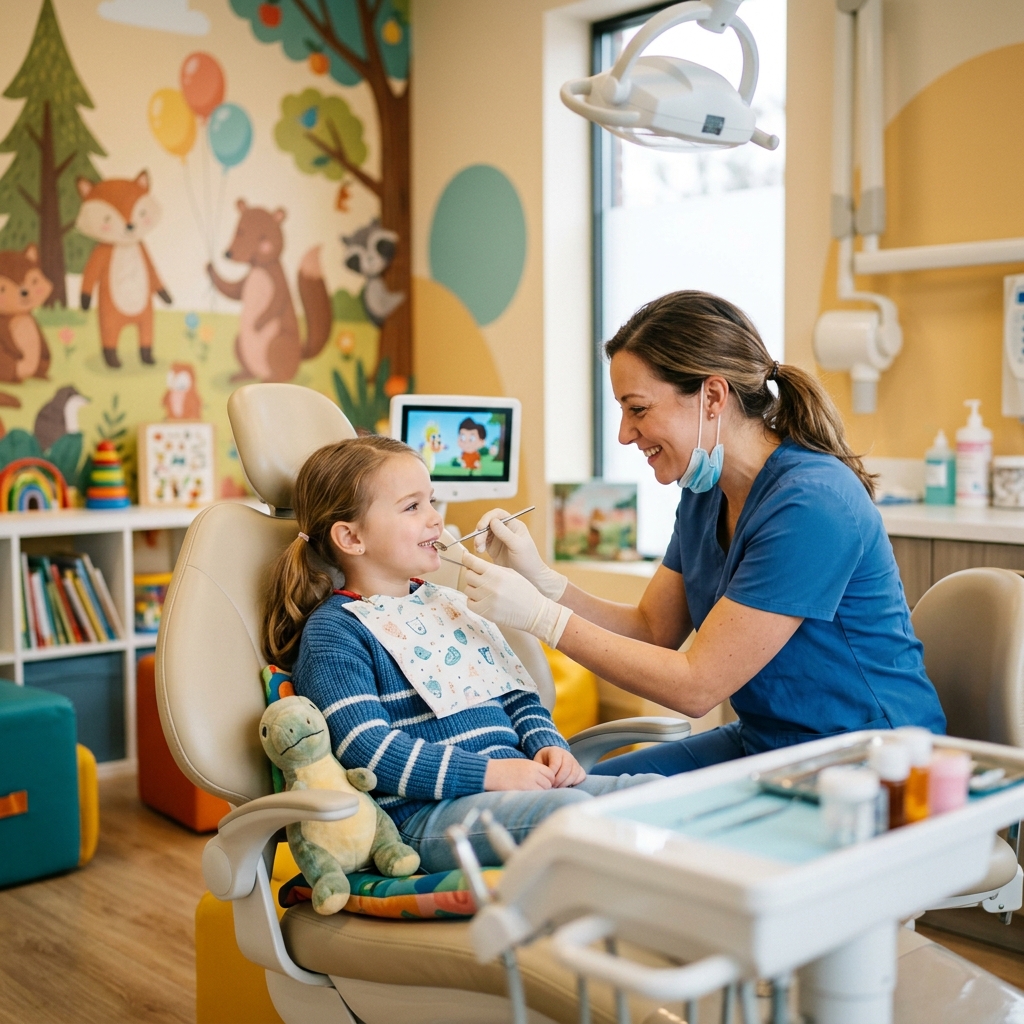
In a hospital pre-operative holding area, that difference is measured in the smoothness of induction, the cooperation of the patient, and the emotional condition of the family accompanying them. In a dental practice, it is measured in chair time, in the number of appointments that run on schedule, and in the reviews families leave afterward. In an inoculation clinic or blood draw center, it is measured in throughput — in how many patients move through the space efficiently, and how many encounters require intervention before care can begin.
The investment is nominal. A wall mural or a framed image. An app accessed from a mobile device. No servers, no software, no technical integration. A wifi connection that every clinical setting already has.
What that investment produces is not nominal at all. It is a clinical encounter that begins differently — because the room was designed to change the condition of the child before anyone in a uniform walked through the door.
Calm as an Operational Asset
In every clinical setting, time is the resource that is always running short. A room designed to reduce the demand on that time is not a luxury. It is an operational asset.
Cosmos Continuum builds experiences with that equation in mind. The human case and the operational case are, in the end, the same case. A calmer child is a better patient. A better patient is a more efficient encounter. A more efficient encounter is a better day for everyone in the building.
The Middle Moment has always been there. It has simply never been designed for.
Learn More
👉 Discover why AR makes Cosmos uniquely suited for hospitals,
clinics, and therapy spaces.