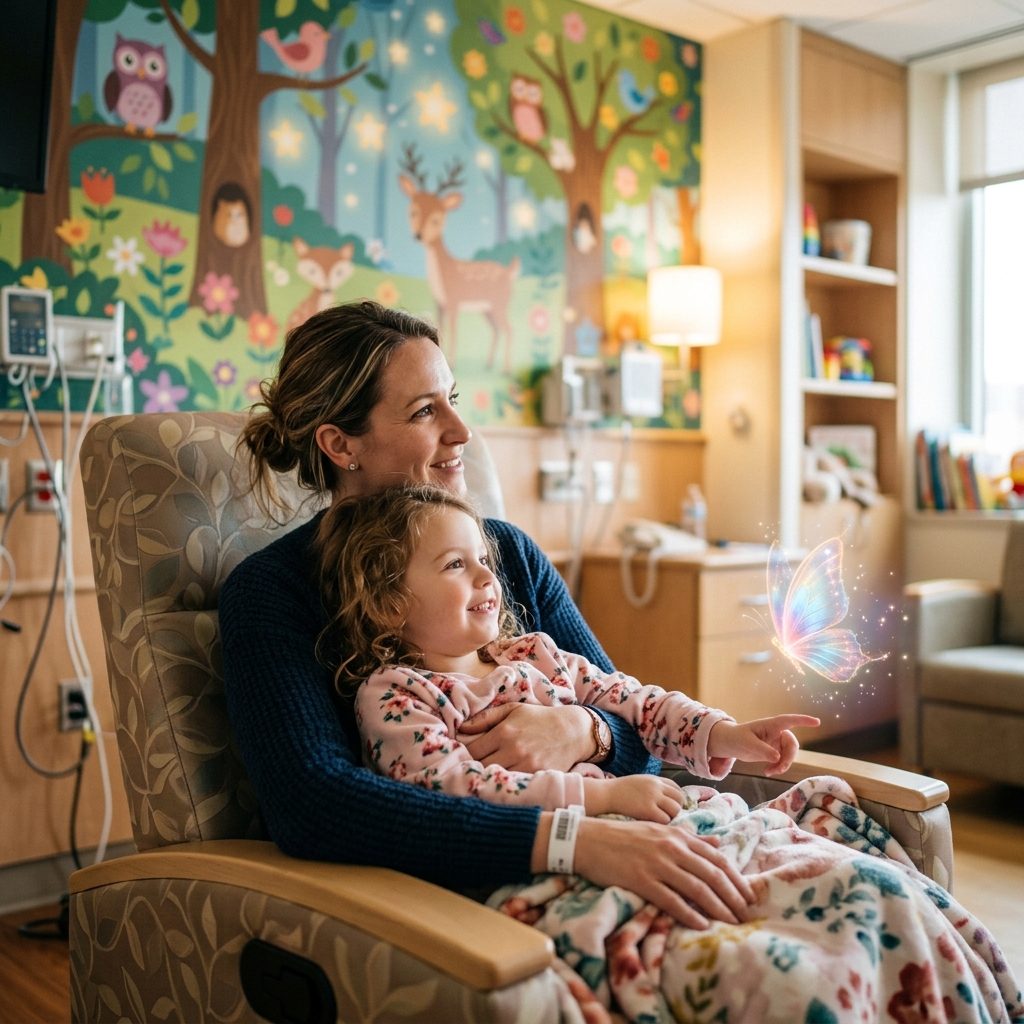
They are watching their child's face. They are managing their own fear — the particular fear that belongs only to parents, the one that has no professional distance to hide behind and no training to fall back on. They are trying not to show what they are feeling, because they know, the way parents always know, that their child is reading them. And their child is reading them.
The Conversation of Two Nervous Systems
This is the part of The Middle Moment that rarely gets named. The child is not experiencing fear in isolation. They are experiencing it in a room with a parent who is also afraid, also uncertain, also waiting for something they cannot control.
The two nervous systems are in conversation. The child looks to the parent for the signal that this moment is safe. The parent, doing their best, tries to send that signal. But the body is honest in ways that words are not.
When the child's fear rises, the parent feels it. When the parent's anxiety tightens, the child reads it. It is not a failure of love or will — it is biology. Two people who are closely bonded, in a moment of shared uncertainty, regulating each other in real time. The clinical term for it is co-regulation. The parental experience of it is something closer to helplessness.
Guided Agency: A Moment to Exhale
What Guided Agency offers the parent is something they are rarely given in that room: a moment to exhale.
When a child finds something to engage with — a world to explore, a rhythm to follow, something that is genuinely theirs to direct — the parent witnesses a shift. The rigid shoulders soften. The face that was scanning the room for threat turns toward something with curiosity instead. The child is no longer waiting for something to happen to them. They are doing something. And the parent, reading that, begins to release what they have been holding.
The Loop in Reverse
That release is not incidental. It is the co-regulation loop running in reverse — the child's calm becoming the parent's calm, the same way the parent's fear had been becoming the child's.
A mother who watched her child engage with StoryWall before surgery described it simply: when you can take your attention off what is about to happen, even for a moment, you forget a little that you're there at all.
That forgetting — brief, imperfect, and entirely human — is its own form of relief. And the child feels that too.
Shifting the Room
A child who goes into a clinical encounter accompanied by a calmer parent is in a different position than one who goes in accompanied by a frightened one. The room has shifted. Not because the procedure changed, or the equipment changed, or anything clinical changed. Because two nervous systems found something to orient toward together, and arrived at the moment of care in a different condition than they would have otherwise.
That is what a room designed for The Middle Moment can do. Not just for the child sitting in it — but for the parent sitting beside them, trying to be brave, trying not to show it, and quietly desperate for something that makes the moment feel less like something happening to both of them.
The room can offer that. It simply has to be designed to.
Learn More
👉 Discover why AR makes Cosmos uniquely suited for hospitals,
clinics, and therapy spaces.