Shifting Focus Beyond the Threshold
Much of healthcare innovation has focused on what happens before a patient arrives and after they leave—scheduling systems, digital check-in, billing workflows, and follow-up
communication. Yet the most fragile part of pediatric care occurs in between. It happens inside the space itself, in the minutes leading up to engagement with clinicians.
Perception Before Interaction
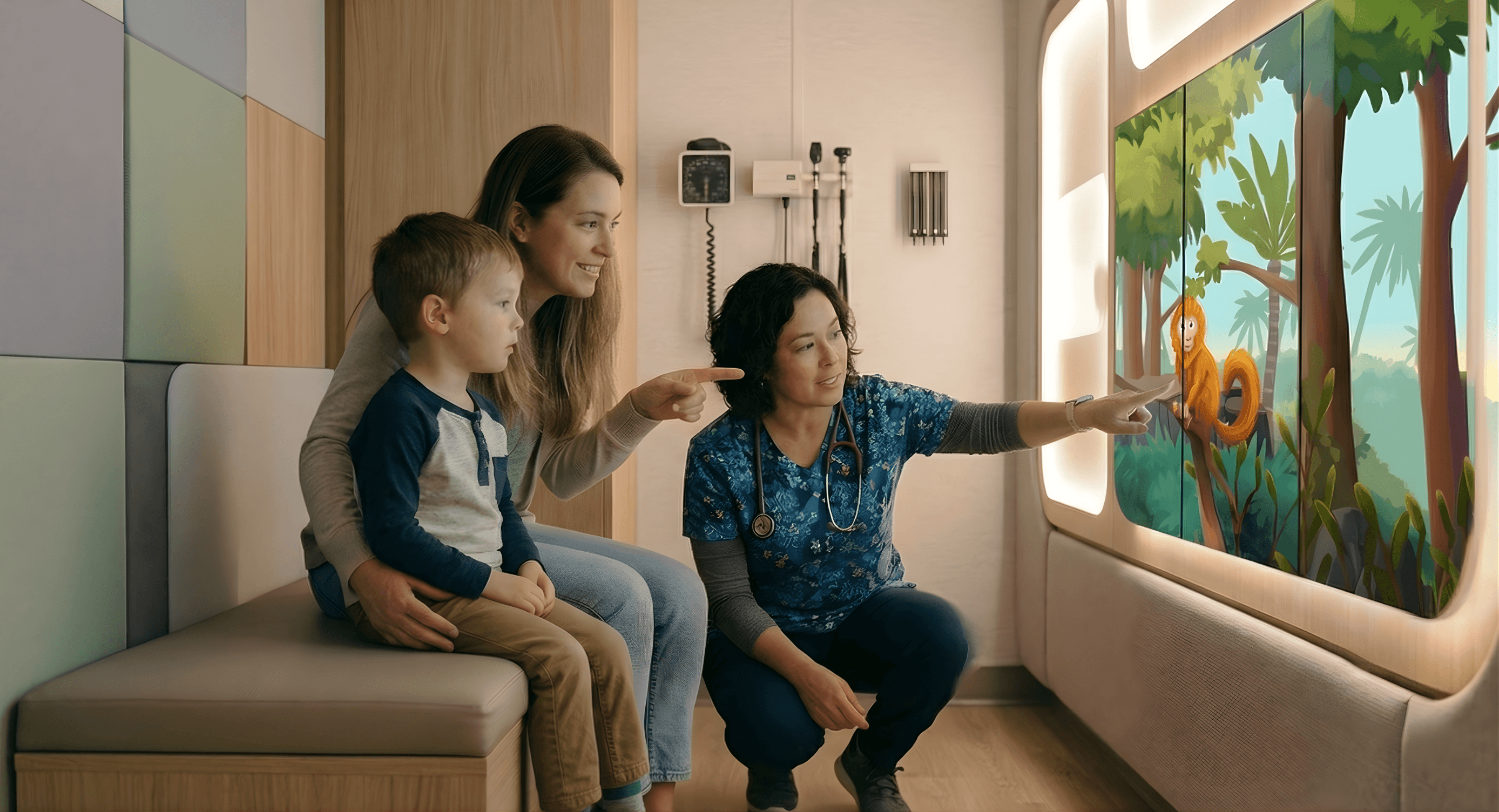
Inside the pediatric space — particularly in the minutes leading up to engagement with clinicians — children are not passive observers. They are scanning, interpreting, and
forming impressions long before hands-on care begins. That in-visit experience is what we refer to as the Middle Moment, and it unfolds whether the room is intentionally
designed for it or not.
When we treat the environment as a backdrop, we place the full weight of that experience on human interaction. Every shift in tone, every calming phrase, every attempt to
redirect attention must come from a person. The room remains visually present but functionally silent.
Defining Participation in Design
A participating environment changes that dynamic. Participation does not mean animation or spectacle. It does not require constant stimulation. It means the room
contributes to the tone and direction of the encounter in ways that align with clinical care.
- Steadiness: Offering a focal point before medical equipment dominates the room.
- Reinforcement: Supporting instructions rather than competing with them.
- Orientation: Providing a sense of place before uncertainty sets in.
It also gives the child something in the environment they can follow, notice, or engage with as the experience begins to take shape around them.
Shaping Attention and Flow
This is a subtle shift in thinking. Instead of asking how a space looks, or even how it reacts, we begin asking how it supports the flow of the visit. Does
it help shape attention? Does it reinforce calm? Does it give the child a way to engage with the space while clinicians guide what comes next?
When the environment participates, clinicians are not working alone to guide the experience. The space supports what they are trying to accomplish.
A breathing cue that remains visible during explanation can make a simple instruction easier to follow. A steady visual progression can give attention somewhere
structured to rest. Solutions such as StoryWall and Breathe With Me were developed around this idea — not as features layered onto a room, but as elements that
actively reinforce care during the Middle Moment.
Amplifying Human Connection
This does not diminish the importance of human presence. Pediatric care will always depend on empathy, communication, and trust. But empathy should not have
to compete with the environment. When the room is intentionally structured, it can amplify reassurance rather than distract from it.
Participation also changes how we think about responsibility. If the environment contributes to the experience, then design becomes part of care delivery.
The room is no longer neutral infrastructure; it becomes an active component of preparation.
The Future of Coherent Care
As pediatric spaces continue to evolve, the most meaningful advancements may not be the most visible. They may be the ones that make the experience feel
more coherent — where human interaction and environmental design move in the same direction.
In the Middle Moment, that alignment matters. The child may not consciously register how the room supported them. But they will feel whether the experience
unfolded with steadiness or strain. A participating environment does not replace clinicians. It stands with them.
Learn More
👉 Discover why AR makes Cosmos uniquely suited for hospitals,
clinics, and therapy spaces.