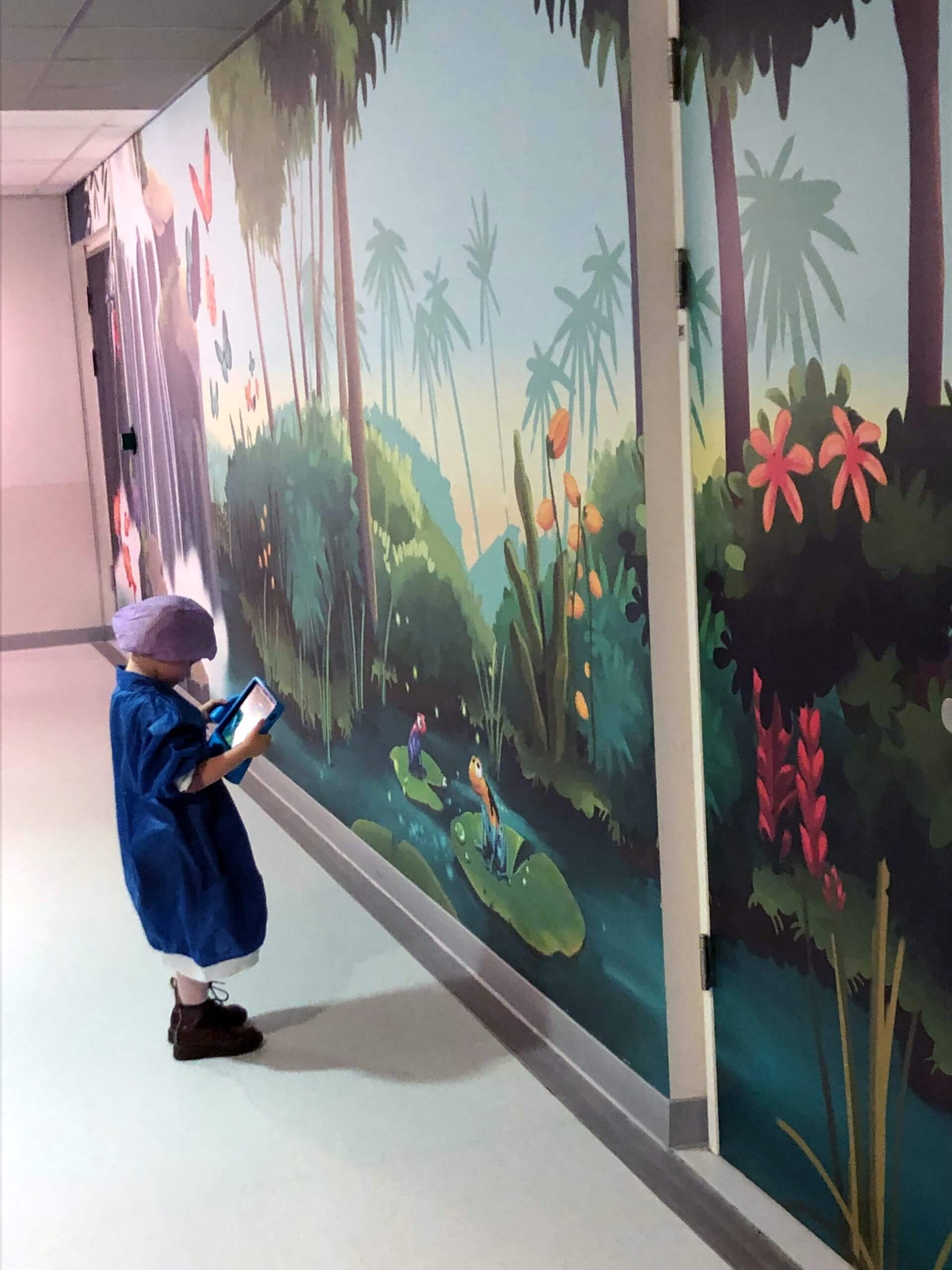
The Middle Moment™ is not exclusively a hospital phenomenon. It happens everywhere a child sits in a clinical chair and waits for something they didn’t choose and can’t control.
The Same Moment, Different Rooms
Consider where children actually encounter clinical care most often. A dental chair. A blood draw center. A pharmacy inoculation bay. An urgent care room. A community health center exam room.
These settings see enormous volumes of pediatric patients. They operate on tight schedules and tighter margins. They were designed for efficiency and the clinical work itself regardless of the age of the patient.
In every one of those settings, a child’s nervous system is doing the same thing — scanning the environment, running its assessment, looking for something to hold onto. The time available for that assessment, however, varies significantly. And that difference determines what the room needs to offer.
The first is the extended Middle Moment. This is the waiting room, the dental reception area, the exam room where a child arrives and waits for several minutes before care begins. The nervous system has time to build a case for fear — or, with the right environment, to settle into something closer to curiosity.
The second is the acute Middle Moment. This is the thirty seconds before a needle, the blood draw, the vaccine, the suture. The window is short. What the child’s nervous system needs is immediate — something steady, something that gives them a rhythm to follow rather than a world to explore. The design response to the acute Middle Moment is regulation, not exploration.
Both are real. Both are predictable. And both can be designed for.
What Happens When They Aren’t
A phlebotomist at a blood draw center did not train to manage a frightened child. Neither did the pharmacy technician administering a vaccine, or the urgent care nurse preparing a suture. Their skill is the clinical work. The emotional work of a child in crisis arrives on top of it, unscheduled and without tools.
A cooperative blood draw takes four minutes. A frightened one can take fifteen — and the delay cascades through every appointment that follows. In a setting where throughput is the operational model, a single difficult encounter can compromise the entire day. The failed draw — where a child’s distress makes the procedure impossible — means a return visit, with a child who arrives already carrying the memory of the first.
Research published in ScienceDirect (2025) found that previous painful experiences and fear of needles can lead to avoidance of medical procedures entirely. The child who had a poorly managed blood draw at age four arrives at the phlebotomy chair at age seven already carrying it. The room that produced that first experience contributed to what every subsequent room will have to manage.
And the staff absorb it. When a frightened child is part of every shift, in every room, without anything in the environment designed to help, the weight accumulates quietly — in the erosion that precedes burnout, in the reviews parents write when they leave, in the operational inefficiency that nobody tracks but everyone feels.
This is not a hospital problem. It is a pediatric care problem. And it is most acute precisely where the least infrastructure exists to address it.
The Right Tool for Each Moment
The design response to each kind of Middle Moment follows from what the moment actually requires.
In a dental practice, the extended Middle Moment happens in the waiting room — where a child sits, anticipates, and waits for their name to be called. A wall that gives that child something to genuinely engage with, something to explore on their own terms, can change the emotional state they bring to the chair. StoryWall™ is designed for exactly that interval — a mural that comes to life through any smartphone or tablet, giving the child a world to discover while the waiting room does its waiting.
In blood draw centers, pharmacy inoculation bays, and urgent care rooms, the picture is different. The wait is brief and the procedure arrives quickly. What the child’s nervous system needs is immediate regulation — something steady to follow, something that gives them a rhythm to hold onto in the thirty seconds before the needle. Breathe With Me™ is designed for that moment. A framed image on the wall, a mobile device, and a giraffe that breathes slowly while dandelion seeds drift with each exhale. The child follows. The breath slows. The phlebotomist doesn’t need a new protocol. The design does what it was designed to do, independently, while the clinical work proceeds.
Neither solution requires servers, software installation, or IT involvement. A mobile device and a basic connection. The barrier between the decision to act and the ability to act is as low as it has ever been in pediatric environment design.
A Different Kind of Competitive Advantage
In retail and diagnostic healthcare, the clinical offering is largely identical across providers. The needle is the same wherever a patient goes. What is different — what can be different — is the experience of being a child in that chair.
A facility that can tell a parent “we have something that helps children feel more at ease before their blood draw” is offering something no competitor in that market is likely offering. For multi-location operations, that advantage compounds. It becomes part of the brand, not just the building. The parent who brings their child back — and who tells other parents — is responding to an experience the room created before anyone spoke.
The participating room is as relevant in a pharmacy inoculation bay as it is in a pre-operative holding area. The child’s nervous system doesn’t distinguish between settings. What changes the outcome in both cases is the same: a room that was designed to give the child something of their own in the moment that matters.
Next in the series: What It Costs a Facility Not to Have a Participating Room
Learn More
👉 Discover why AR makes Cosmos uniquely suited for hospitals,
clinics, and therapy spaces.