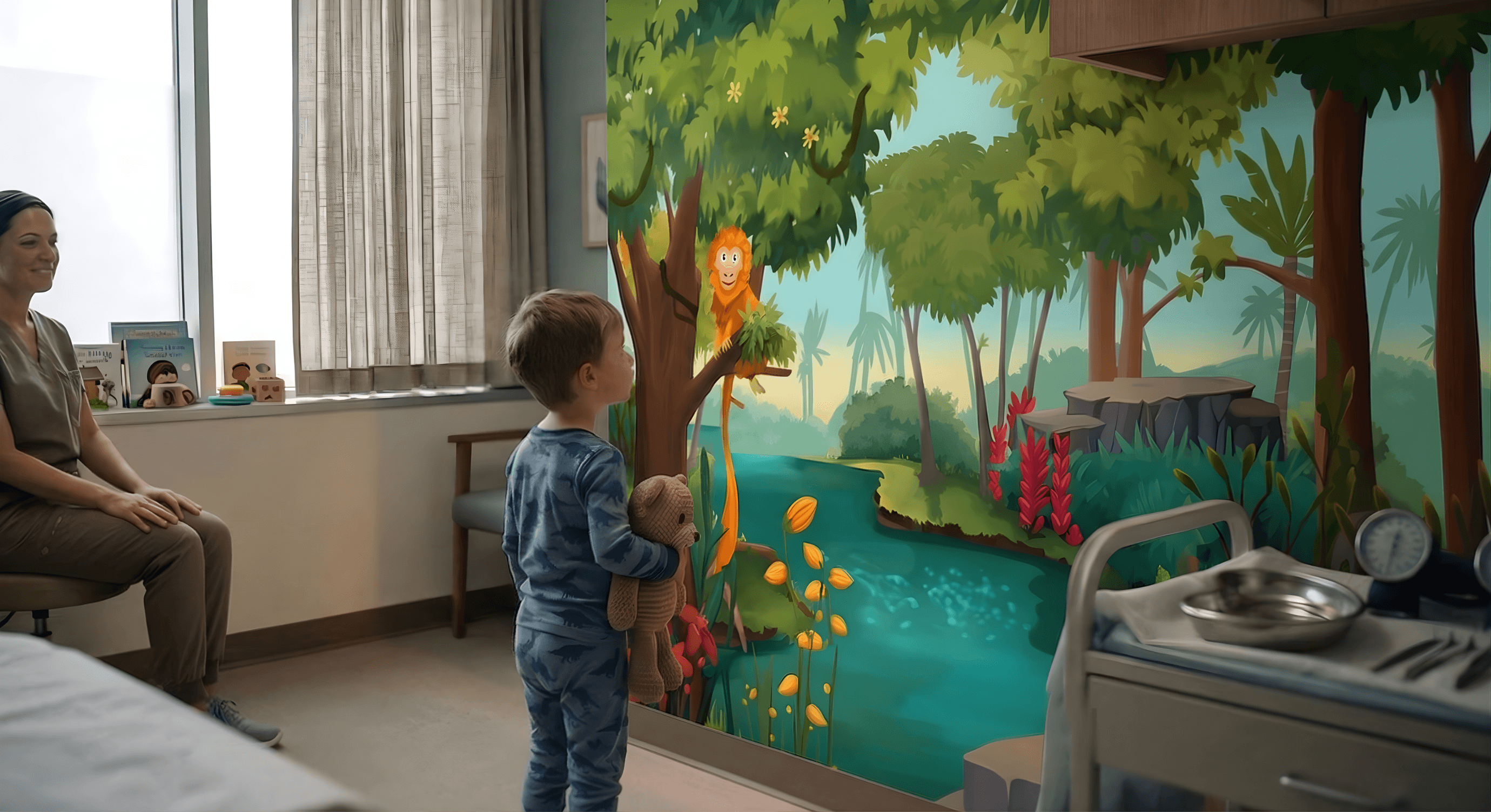
The Myth of the Neutral Backdrop
We often think of pediatric rooms as neutral backdrops — simply the spaces where care unfolds.
And when they are designed, the focus is often on making them feel welcoming: murals on the walls,
artwork on the ceiling, softer color palettes, familiar themes. These choices communicate that children were considered,
that the space is meant to feel less clinical and more inviting. That matters. But welcoming is not the same as preparing.
Defining “The Middle Moment”
The most fragile part of pediatric care happens inside the space itself, in the time leading up to engagement with clinicians.
That’s The Middle Moment. It is the lived experience inside the pediatric space — those minutes when attention narrows and a child begins to interpret what is about to happen.
If the room is silent in that moment, it still communicates something. If equipment dominates the visual field, that communicates something.
If there is no clear focal point, attention will settle wherever it can.
Decoration Changes Looks; Design Shapes Function
This is where the distinction between decoration and design becomes important.
Decoration changes how a room looks. Design shapes how it functions. A mural may soften first impressions,
but it cannot guide attention once a child is inside the space.
When a child enters the room and their attention narrows, it doesn’t drift randomly. It begins searching for something steady or predictable that helps them make sense of the moment.
A predictable focal element, a steady visual anchor, or a structured point of engagement can influence how the in-visit experience unfolds. Without that structure,
clinicians carry the full burden of calming and orienting the child while the environment remains passive.
Beyond the Mural: An Invitation to Look Deeper
This is not a critique of child-friendly décor. It is an invitation to look deeper. If we accept that The Middle Moment is predictable — that it occurs inside the pediatric space,
before hands-on care begins — then it deserves intentional design.
The pediatric room is not neutral. It either reinforces steadiness or leaves that responsibility entirely to the people within it.
Creating Better Outcomes
Recognizing that reality changes how we think about pediatric environments. The question is no longer whether a room feels welcoming on entry.
It is whether it is prepared for the part of care that happens between arrival and departure — the part the child experiences most directly.
Learn More
👉 Discover why AR makes Cosmos uniquely suited for hospitals,
clinics, and therapy spaces.