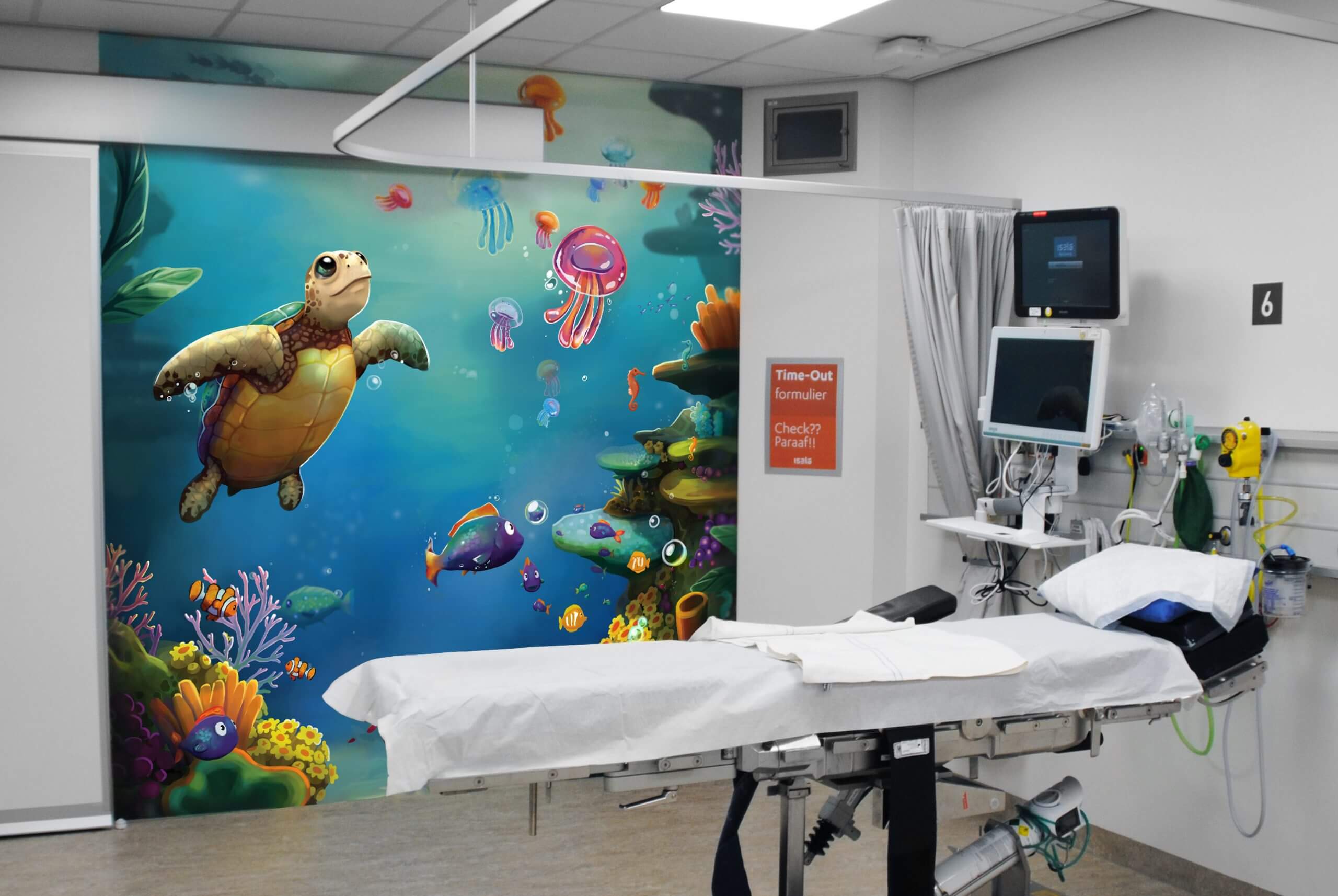
The participating room has been described in conceptual terms — what it is, what it does, how it differs from a welcoming room, why distraction falls short of it, and how the calm it creates ripples outward through everyone in the encounter. Now it’s worth asking the practical question: what does a participating room actually look like — not in principle, but in practice, on a wall, in a room, with a child in it?
The Answer Starts With the Wall
Previously, we examined the wall as the room’s most underused surface — the largest, most visible element in any pediatric space, present at every height from floor to ceiling, free from the functional obligations that constrain the floor, the ceiling, and the furniture.
We identified what a wall would need to do to qualify as genuinely engaging rather than merely decorative. It would need to offer the child something to do, not just something to see. The interaction would need to be directed by the child, not scripted by the room. It would need to work without requiring staff involvement — operating independently, requiring nothing from the clinical team to initiate or maintain. It would need to be accessible without friction — no instructions, no permissions, no waiting for the right moment. And it would need to operate without involving the facility’s IT infrastructure — no servers, no software installation, no technology integration of any kind. Just a mobile device and a basic connection.
A wall that meets those criteria is more than a mural. More than a painted scene or a character from a children’s television program. It’s something categorically different — a surface that responds to the child, changes based on their engagement, and gives them genuine agency in the space.
A Room in the Netherlands
The pre-operative setting is one of the most consequential Middle Moments in pediatric care. Research published in medRxiv (2026) found that preoperative anxiety affects 50–75% of children undergoing surgical procedures. Children experiencing high preoperative anxiety face increased risk of difficult anesthesia induction, prolonged recovery times, and the development of negative healthcare attitudes that persist well beyond the encounter. The stakes of what happens in that waiting space are significant.
In a pre-operative holding area at Isala Hospital in the Netherlands, children preparing for surgery encounter a wall that addresses those stakes directly.
The wall carries a mural. But when a child points a smartphone or tablet at it, the mural comes to life. An underwater world appears — creatures move, details emerge, discoveries wait. The child chooses where to look, what to find, what to explore. Nothing is scripted. Nothing requires a staff member to initiate or explain. The digital layer is additive — the room remains real, the parent remains visible and present, the child stays connected to both. But within that reality, the child has a world that is genuinely theirs to direct.
What clinicians and parents at Isala observed was straightforward. The children who engaged with the wall during The Middle Moment™ arrived at the moment of anesthesia induction in a different emotional state than those who had not. The rigid posture of a child preparing for threat had softened. The face that had been scanning the room for danger had turned — toward curiosity, toward the world on the wall, toward something that was theirs.
The room had participated. And the encounter that followed reflected it.
What Makes It Work
The Isala experience is built on a product called StoryWall™, developed by Cosmos Continuum. It is available in ocean and jungle themes, and it activates through the free Cosmos app on any smartphone or tablet. No servers. No software installation. No integration with the facility’s technology infrastructure. A wifi connection works. So does a standard mobile data plan.
The facility licenses the wall imagery — the mural itself — and the experience is available from that point forward to every child who enters the room with a device. Siblings can share it. Parents can participate. The clinical team doesn’t need to manage it, explain it, or be present for it to work.
That simplicity is intentional. A solution that requires staff involvement to function is a solution that adds to the burden it was meant to relieve. StoryWall was designed to operate alongside the clinical team — not instead of them, but independently of them — so that when the clinician walks through the door, the room has already done what it was designed to do.
What the Child Experiences
A child who enters a room with StoryWall on the wall encounters something they haven’t encountered in a clinical space before: something that is theirs.
Not something placed there to calm them down. Not a screen playing content at them. Something they can direct — point the device here, discover this creature, look over there and find something different. The choices are theirs. The world responds to where they look and what they engage with. The experience doesn’t tell them what to do. It gives them something worth doing.
A child who can choose, direct, and engage with something they can control arrives at the clinical moment in a different emotional state than one who was simply distracted. Research published by PMC/NIH (2019) found that a greater sense of control is correlated with better outcomes across multiple domains for children in stressful settings. StoryWall is what that looks like when it has been designed into a wall.
A Question Worth Asking Now
The question each facility has to ask for itself: what is our room currently saying to the children inside it? And is that what we would choose to say, if we were choosing deliberately?
For facilities ready to ask that question seriously — and to explore what a participating room could look like in their specific setting — Cosmos Continuum is the place to begin that conversation.
Next in the series: The Participating Room Beyond the Hospital
Learn More
👉 Discover why AR makes Cosmos uniquely suited for hospitals,
clinics, and therapy spaces.