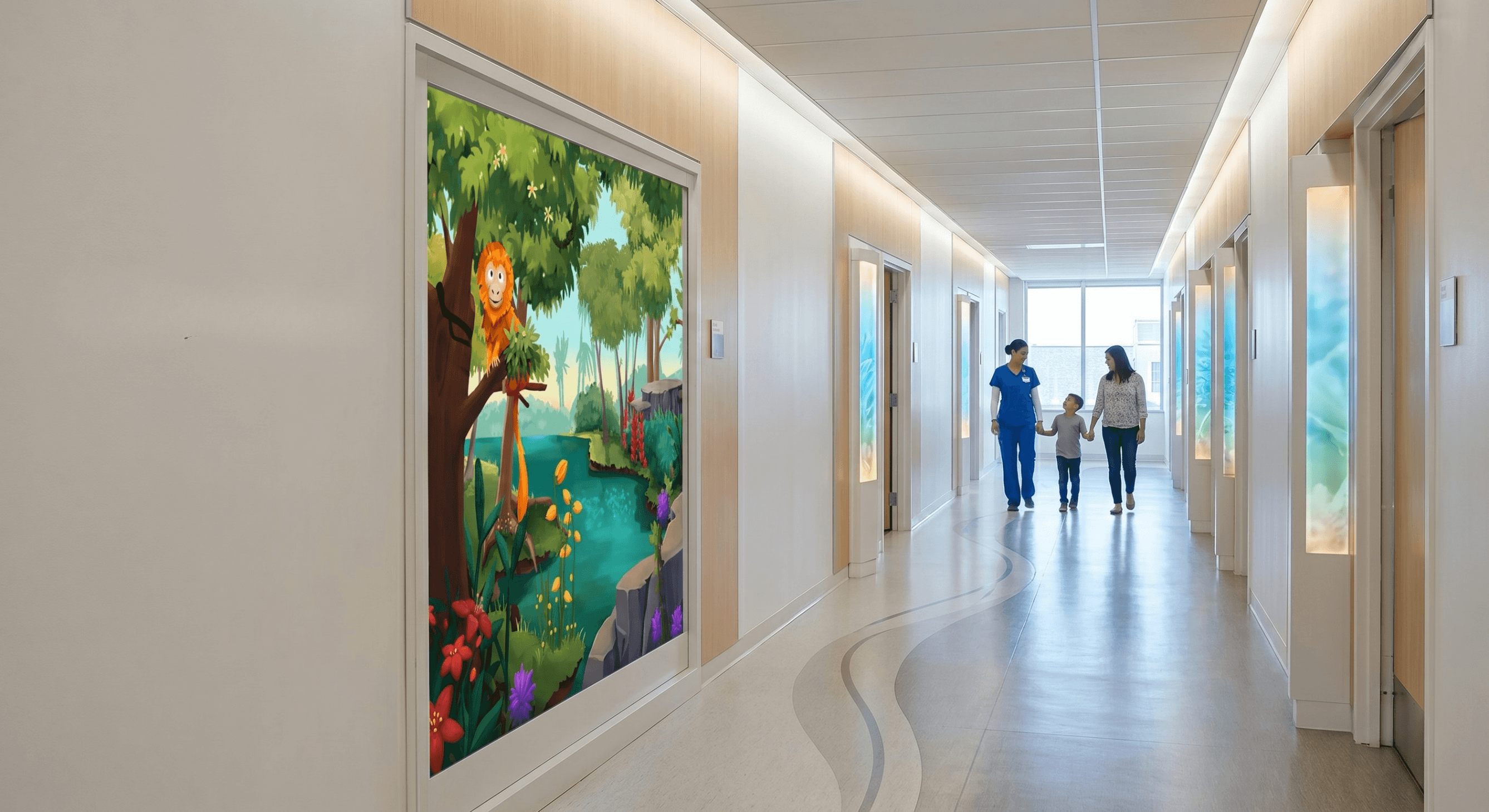
Designing for the Predictable
If we accept that the Middle Moment is predictable, that every pediatric visit includes a period inside the room before hands-on care begins, then the experience during
that time should not be incidental. It should be expected. And what is expected can be standardized.
This does not mean every pediatric room should look identical. It means every pediatric room should function with intention.
Structural Elements of Engagement
A predictable focal anchor. A consistent method for guiding attention. A visual language that reinforces, rather than competes with, clinical explanation. Elements that give
children something steady in the environment they can orient to as the visit unfolds. These are not aesthetic choices; they are structural ones. When applied consistently,
they create continuity across departments and facilities.
The Power of Environmental Continuity
That continuity matters more than it might appear. Children who require repeated visits, imaging, infusion, procedures, follow-up care, do not experience each appointment
in isolation. They build expectations based on previous encounters. When environments differ widely in how they support the Middle Moment, the experience can feel
fragmented. When environmental support is consistent, the experience becomes more coherent over time.
For institutions, this coherence carries practical implications as well. Clinicians move between rooms. Staff turnover occurs. Protocols evolve. When environmental
structure is embedded into the space itself, it reduces reliance on individual variation. The room reinforces the tone of care regardless of who is present.
Scalability and Emotional Architecture
Solutions such as StoryWall and Breathe With Me were designed with this scalability in mind. They are not one-time enhancements, but adaptable frameworks that
can be implemented consistently across multiple settings. In that way, intentional design becomes replicable rather than situational.
This is where emotional architecture intersects with institutional leadership. When the environment is treated as part of the care model rather than as décor,
it becomes eligible for the same strategic thinking applied to other systems. It can be evaluated, refined, and expanded.
Standardizing Trust
Standardization does not diminish humanity; in pediatric care, it can protect it. When children encounter steadiness across every room and every visit,
trust builds more naturally and familiarity reduces friction. The Middle Moment begins to feel less unpredictable because the environment itself has
become consistent.
Over time, that consistency does more than calm the moment. It allows children to recognize and engage with the environment in ways that make the
experience feel more familiar and manageable. As familiarity grows, expectations begin to shift — not only for children and families, but for clinicians
as well. The environment becomes a reliable partner rather than a variable.
When participation becomes standard, the pediatric room is no longer an isolated project. It becomes part of the institution’s identity.
Learn More
👉 Discover why AR makes Cosmos uniquely suited for hospitals,
clinics, and therapy spaces.