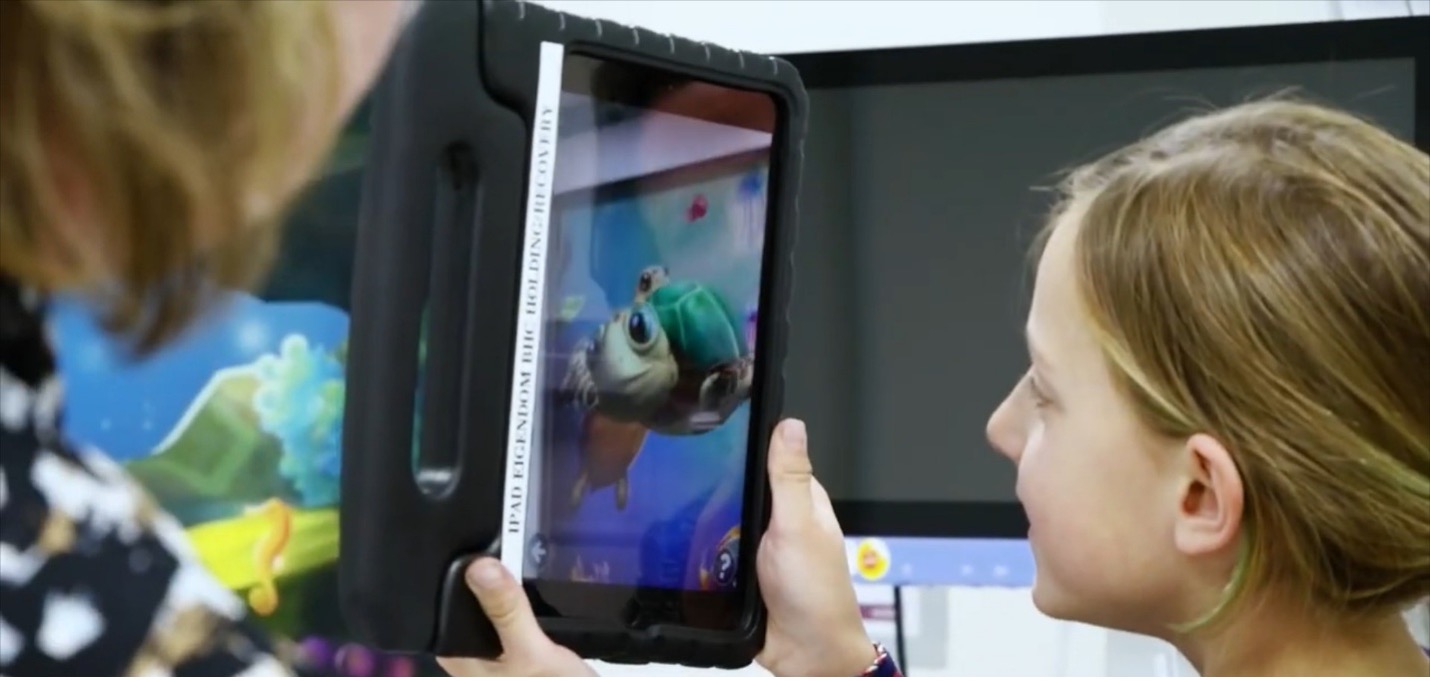
Walk into almost any pediatric clinical setting that has made a deliberate effort to address child anxiety, and you will find some version of the same solution. A tablet propped on the counter. A cartoon playing on a mounted screen. A video running in the corner of the waiting room. In more sophisticated implementations, a ceiling covered in projected images, or a screen above the examination table designed to capture a child’s gaze during a procedure.
These are well-intentioned responses to a real problem. The people who implemented them saw frightened children and wanted to help. That instinct is right. The tool is incomplete.
What Distraction Does
Distraction works by redirecting attention. It gives the child’s eyes and ears somewhere to go that is not the equipment on the counter, the sound of the room next door, or the door that is about to open. For a period of time — sometimes a meaningful one — the child’s attention is genuinely somewhere else.
A child who is watching something engaging is, in that moment, calmer than one who is not. The room is quieter. The parent exhales a little. The clinical team has a window to work in.
But distraction has a structural limitation that no amount of better content can overcome. It’s passive. The child watches. They receive. Nothing about what is happening on the screen responds to them, changes because of them, or belongs to them. The tablet plays its video whether the child is in the room or not.
And because distraction is passive, it’s fragile. It holds attention until something breaks it — an unexpected sound, a movement at the door, the appearance of a needle, the moment the clinician’s hand approaches. When attention snaps back to the room, what it finds is exactly what it left: an environment that has done nothing to change the child’s underlying emotional state. The fear that was there before the screen came on is still there. And it often returns harder than before, because the interval of distraction has not given the nervous system anywhere to go. It has simply delayed the reckoning.
The Difference the Nervous System Recognizes
A child’s nervous system is not fooled by distraction. It may be temporarily occupied by it, but the assessment doesn’t stop because a video is playing. It continues in the background, drawing on the same environmental signals it was reading before the screen appeared.
What changes the nervous system’s assessment is not occupying its attention. It’s answering its questions: Is there anything here that is mine? Something I can choose? Something I can direct? Something that responds to me rather than simply happening around me?
Distraction doesn’t answer those questions. It sidesteps them — temporarily, and incompletely. A child watching a cartoon is still a child who has no agency in the room. The screen is there whether they watch it or not. They can’t change what plays or determine what happens next. They are a spectator.
Genuine agency answers the question directly. When a child has something they can genuinely engage with — something that responds to their choices, that they can direct, that gives them a real experience of control in the space — the nervous system receives a different signal. Not your attention has been redirected but you have a role here. That distinction is not just semantics. It is the difference between a nervous system that is occupied and one that is regulated.
Research published in the World Journal of Clinical Pediatrics (Lerwick, 2016) found that children experience psychological distress in healthcare settings primarily because they lack control of their environment — that the sense of helplessness, rather than the procedure itself, is the root driver of resistance and escalation. Distraction does not address that root. Agency does.
Why This Matters at the Moment That Counts
The distinction between distraction and agency can seem like a fine line. In practice, it is not.
Consider what happens in the seconds before a procedure begins. A child who has been watching a video during The Middle Moment™ has had their attention occupied but their emotional state unchanged. When the clinician approaches — when the environment makes it clear that the moment has arrived — attention snaps back to the room. The nervous system delivers its conclusion: nothing here is within my control. Prepare accordingly.
A child who has spent that same interval with genuine agency has had a different experience. They have been doing something. Choosing something. Directing something that responded to them. Their nervous system has received signals that are not available in a distracted environment: I have a role here. Something in this space responds to me. This moment is not entirely outside my reach.
That child arrives at the clinical moment in a different emotional state. Not fearless — the nervous system doesn’t switch off its assessment simply because the environment has been thoughtfully designed. But regulated. Calmer. More capable of tolerating what comes next. And that difference — which begins in The Middle Moment and carries into the encounter — is visible to every person in the room.
A 2023 systematic review published by PMC/NIH, examining non-pharmacological interventions in pediatric patients across more than two decades of research, found that designed experiences which actively engage children — rather than simply occupy them — produce measurable reductions in anxiety and stress. This was confirmed through salivary cortisol levels. The mechanism that accomplishes this is not distraction. It is agency.
The Burden Distraction Leaves Behind
There’s a cost to distraction that is rarely examined directly. When distraction fails — when the video ends at the wrong moment, when the tablet battery dies, or the child simply stops watching — the responsibility for managing the child’s anxiety passes entirely to the people in the room. The parent. The clinician. The Child Life Specialist if one is present.
This is a burden that no screen was ever going to eliminate, because distraction was never designed to change the child’s underlying emotional state. It was designed to delay the problem. When the delay ends, the problem is still there, and the humans in the room have to absorb it.
A room designed for genuine agency distributes that burden differently. The room is doing something alongside the clinical team — not requiring anything from the staff to maintain it. The clinician walks through the door having inherited a child in a different emotional state.
That’s what a participating room offers that a distraction tool cannot. Because the room was designed to participate.
Next in the series: The Ripple a Calm Room Creates
Learn More
👉 Discover why AR makes Cosmos uniquely suited for hospitals,
clinics, and therapy spaces.