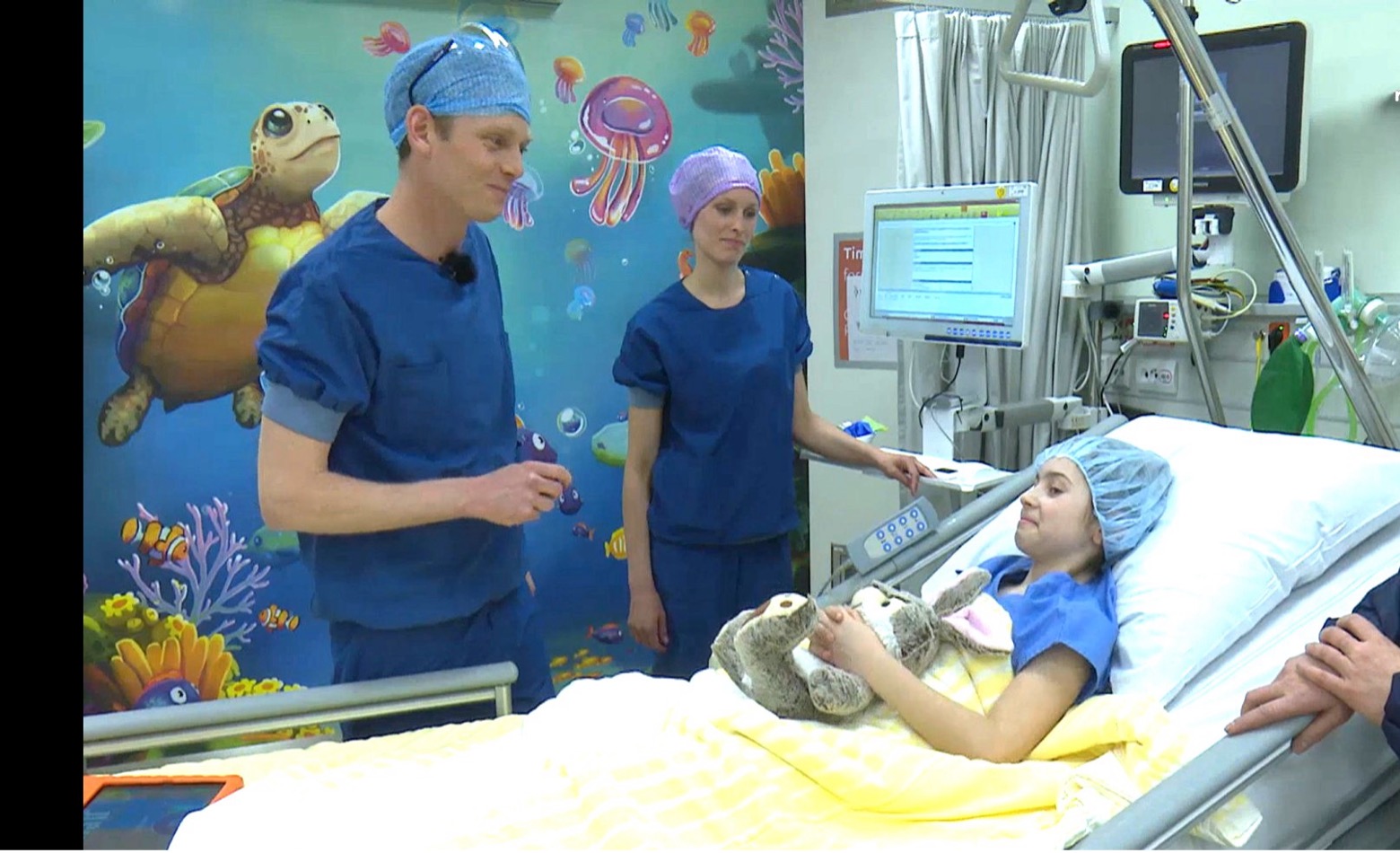
The emotional state of the room in The Middle Moment™ ripples outward in ways that touch every person involved and every minute that follows. It travels — through the child, through the parent, into the clinical encounter, and beyond it. This post examines that ripple.
The Child and the Room
What a room communicates to a child during The Middle Moment shapes the emotional state the child carries into the clinical encounter. A child who has spent The Middle Moment with genuine agency arrives differently than one who has spent it in passive waiting. Their nervous system has received a different signal. One that increases their willingness to cooperate and their capacity to tolerate discomfort. That’s where the ripple begins. (For a fuller discussion of how agency changes the nervous system’s response, see Post 5 in this series: Why Distraction Isn’t Enough.)
The Parent in the Room
There is almost always a parent in that room. They are sitting beside the bed or standing against the wall, watching their child’s face with the particular attention that belongs only to parents — the one with no professional distance to stand behind.
They’re managing their own fear. And they’re trying not to show it, because they know, the way parents always know, that their child is reading them.
And their child is reading them. The two nervous systems are in conversation. When the child’s anxiety rises, the parent feels it. When the parent’s fear tightens, the child receives it. This dynamic — two closely bonded people regulating each other in real time — is called co-regulation. It operates in both directions simultaneously, and it operates whether anyone in the room is aware of it or not.
When a child finds something to genuinely engage with during The Middle Moment — something that orients their attention toward curiosity rather than threat — the parent witnesses a shift. The rigid shoulders soften. The face that was scanning the room for danger turns toward something with curiosity instead. That shift travels. The child’s calm becomes the parent’s calm, the same way the parent’s fear had been becoming the child’s.
A parent who has had a moment to exhale accompanies their child into the clinical encounter in a different emotional state — steadier, more present, better able to provide the support that only a parent can provide. And a child accompanied by a calmer parent arrives at the clinical moment in a better position than one accompanied by an anxious one.
The room didn’t change the parent directly. It changed the child. The parent followed.
The Clinician at the Door
The clinician who walks through the door doesn’t know what version of the room they are walking into. Whether what waits on the other side is a child who is calm and ready, or a child who is not.
Caring for a frightened child — genuinely, humanely, while simultaneously doing the clinical work — asks something that no training fully prepares a person for. It requires absorbing a child’s distress, steadying a parent’s anxiety, and delivering care, all at once. When it happens in every room, every day, the weight accumulates in ways that don’t always announce themselves. The nurse who goes home depleted without knowing exactly why. The clinician who finds the difficult encounters harder than they used to.
When the room has done its work during The Middle Moment, the clinician walks into something different. The first moment of contact is not the management of a crisis. It’s the continuation of a process that has already begun to go well. Across a shift, across a week, across a career, that difference is substantial.
The Operational Ripple
The human ripple has a practical counterpart that shows up in how encounters actually unfold.
A child who arrives at the clinical moment already calm cooperates more readily and tolerates discomfort more effectively. A 2018 study published in PubMed found that higher anxiety in children undergoing procedures results in increased medication requirements and longer procedural durations — with the potential for additional complications. The reverse is equally true: a calmer child moves through the encounter more efficiently, with less demand on staff time and less likelihood of needing additional intervention.
In a hospital, a difficult encounter can often be absorbed into the day. In a dental practice, a blood draw center, or an urgent care clinic — where schedules have less room to flex — a single encounter that runs long can affect every appointment that follows. The emotional cost and the operational cost are the same cost, arriving through different doors.
A room designed to support the child during The Middle Moment addresses both simultaneously. Not by eliminating the difficulty of pediatric care — no room does that — but by changing the emotional state the child brings to the encounter before anyone has spoken.
The Ripple Doesn’t Stop
The ripple doesn’t end when the encounter does. It travels home.
A child who leaves a clinical visit without a memory of fear arrives at the next one carrying less resistance. A parent who watched their child manage — who saw the shoulders soften and the face turn toward curiosity — leaves with a different story than the one they feared they would carry. Both of those outcomes belong to the room as much as to the clinician who delivered care inside it.
The participating room does not perform a procedure. It doesn’t deliver reassurance or replace anything that clinical staff do. What it does is change the emotional starting point of the encounter — for the child, the parent, the clinician, and the memory the family forms of what happened.
That’s what the ripple looks like from the inside.
Next in the series: What a Participating Room Looks Like in Practice
Learn More
👉 Discover why AR makes Cosmos uniquely suited for hospitals,
clinics, and therapy spaces.