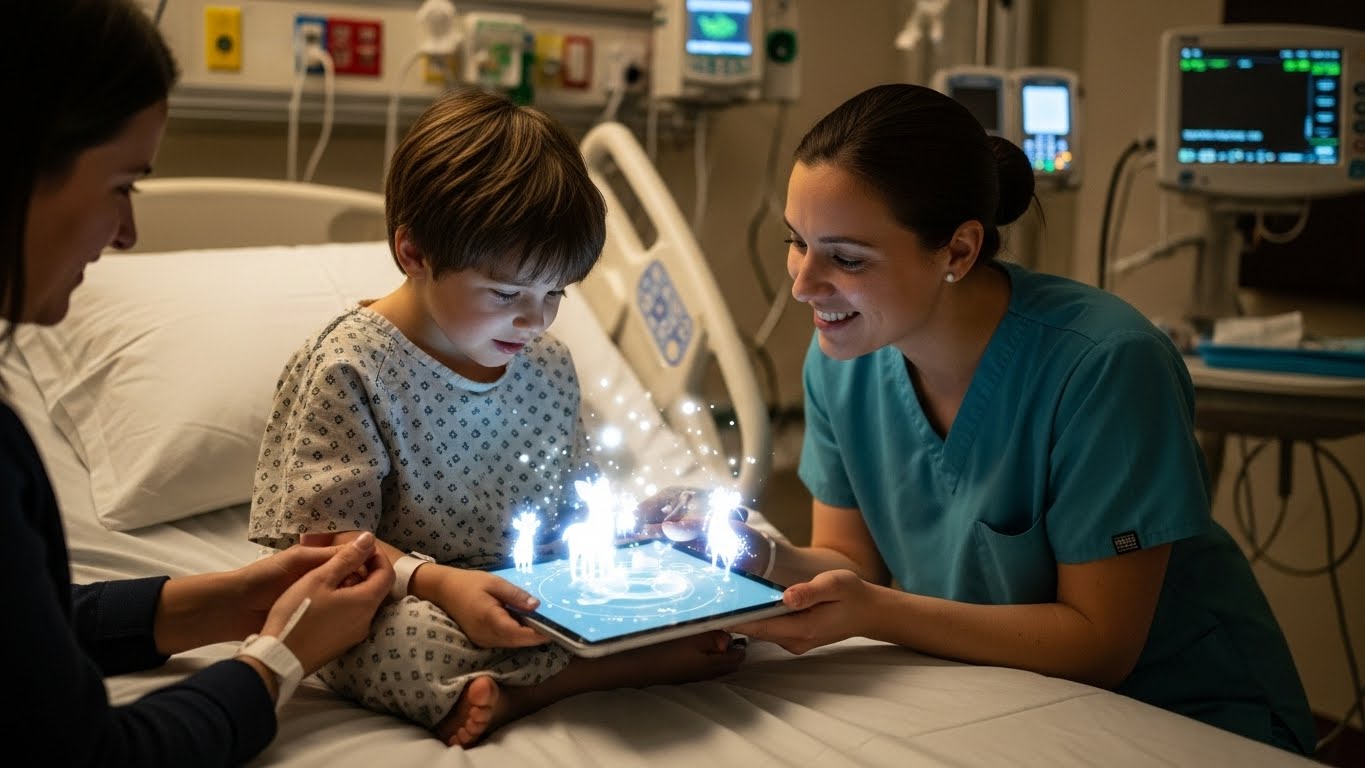
The Emotional Tipping Point
Across pediatrics, the hardest part of care is rarely the diagnosis or the procedure. It’s the
moment in between—the moment when a child is physically present in the room and emotionally trying
to make sense of what’s happening.
This is the Overlooked Middle of Patient Experience—an emotional tipping point in pediatric care.
And while the industry has invested heavily in improving the “before” and “after” experience of
healthcare, the emotional reality in the middle is often left to the individual service provider to
navigate on their own. This is where the room changes. This is where fear becomes visible. This is
where emotional load becomes clinical reality.
What Happens to a Child in the Middle
A child doesn’t experience a visit the way adults do. They don’t understand clinical context or
procedural purpose. They understand only what they feel. And in unfamiliar settings, the body reacts
quickly:
- Stress hormones rise — especially cortisol, the hormone associated with fear
and threat.
- Muscles tighten — preparing for danger rather than cooperation.
- Breathing becomes shallow — a natural response to anxiety.
- Attention narrows — making it difficult to process instructions.
- Pain sensitivity increases — fear amplifies perception.
Studies show that higher fear in children correlates with increased anxiety, greater distress, and
behaviors that complicate care and cooperation (Kain et al., 2006). But you don’t need to be a
clinician to see this happen. Any adult who has watched a child bracing for a shot knows how quickly
fear reshapes the moment.
When this emotional response takes hold, cooperation becomes harder. And when cooperation becomes
harder, procedures slow or stall. Clinicians feel it. Parents feel it. The child feels it more than
anyone. This is not a behavioral problem. It’s biology meeting environment in real time.
Why the Middle Stays Overlooked
Hospitals and health systems aren’t overlooking this moment intentionally. The challenge is
structural. Pediatric emotional experience is difficult to measure, difficult to quantify, and
difficult to tie to metrics that drive operational priorities.
By contrast, the “before” and “after” of care are full of measurable variables:
- Appointment throughput
- Referral accuracy
- Length of stay
- Documentation efficiency
- Billing completeness
- Digital engagement
These things can be digitized, tracked, and optimized. Meanwhile, the middle moment:
- Doesn’t show up in dashboards
- Doesn’t appear in reimbursement reports
- Doesn’t fit neatly into workflow optimization models
- Varies child to child, family to family, room to room
So it slips into the background. And yet it shapes everything.
The Cost of Leaving the Middle Unaddressed
When a child is overwhelmed:
- Procedures take longer
- Appointments run behind
- Clinicians absorb emotional strain
- Parents leave feeling unsettled
- Other patients are affected
- Staff face pressure to “make up time”
- Overall satisfaction drops even when clinical quality is high
The impact is immediate and palpable. A fearful child becomes the emotional center of gravity.
Everything else bends around that fear.
A Different Way of Thinking About Patient Experience
Cosmos Continuum approaches this moment through a different lens. Not with more hardware. Not with
more steps. Not with more complexity layered into an already demanding environment. But with a
simple principle: Technology should support the emotional center of care, not distract from
it.
Human-centered Augmented Reality (AR) offers something other systems rarely do: a way to gently
redirect a child’s attention without adding burden to the clinician or parent. It’s quiet. It’s
soft. It meets the child where they are—curious, uncertain, wanting something familiar to hold onto.
And when a child feels even a little safer, the room shifts with them. It’s about creating just
enough emotional stability for cooperation to become possible again. This makes the Middle Moment
just a little more human.
Learn More
👉 Discover why AR makes Cosmos uniquely suited for hospitals,
clinics, and therapy spaces. Visit
our practitioner page.