The Moment That Matters Most in Pediatric Patient Experience
Across healthcare, Patient Experience (PX) has become one of the defining conversations of our time. Hospitals and health systems are investing heavily in tools that reshape the earliest and latest moments of care—AI-driven intake, automated scheduling, streamlined referrals, clearer billing, and digital follow-up systems. These innovations matter. They reduce friction, close gaps, and create a cleaner pathway into and out of the healthcare journey.
And yet, there is a moment in that journey that rarely receives the attention it deserves—a quiet but defining moment that can outweigh everything else.
It’s the moment during the visit. The moment a child steps into a room that feels unfamiliar. The moment a parent tries to be brave on their child’s behalf. The moment a routine procedure becomes emotionally charged because fear, not illness, takes center stage. No dashboard or automation can change what a child feels in that instant.
Where Technology Stops, Humans Still Feel
AI can refine the logistics of care, but it cannot soften the emotional weight of being in the room. Especially for children. In pediatrics, fear isn’t an abstract concept—it’s a whole-body response. Stress hormones rise. Muscles tighten. Breathing changes. A simple request becomes overwhelming. A routine procedure becomes a struggle. Parents feel it too, often more intensely than they show. And clinicians must navigate not only the medical task, but the emotional atmosphere that surrounds it. This is the “Overlooked Middle” of Patient Experience: the moment when everything slows down or speeds up, depending on how safe a child feels. It may be the quietest point in the patient journey, but it is often the most defining.
Why This Moment Matters So Much
When a child is afraid, cooperation becomes difficult. When cooperation becomes difficult, procedures take longer. When procedures take longer, stress rises—for families and clinicians alike. This isn’t about blame. It’s about recognizing that emotional experience is part of clinical reality. Every pediatric provider knows the difference between a calm room and a tense one. Every parent has seen how a child’s fear can shift the entire energy of a situation. And every administrator has felt the ripple effects when timelines are stretched, staff become overloaded, and parents leave feeling unsettled. Patient Experience is not only a question of efficiency. It is a question of emotional environment. And the emotional environment is shaped inside the visit, not around it.
The Role Cosmos Continuum Plays
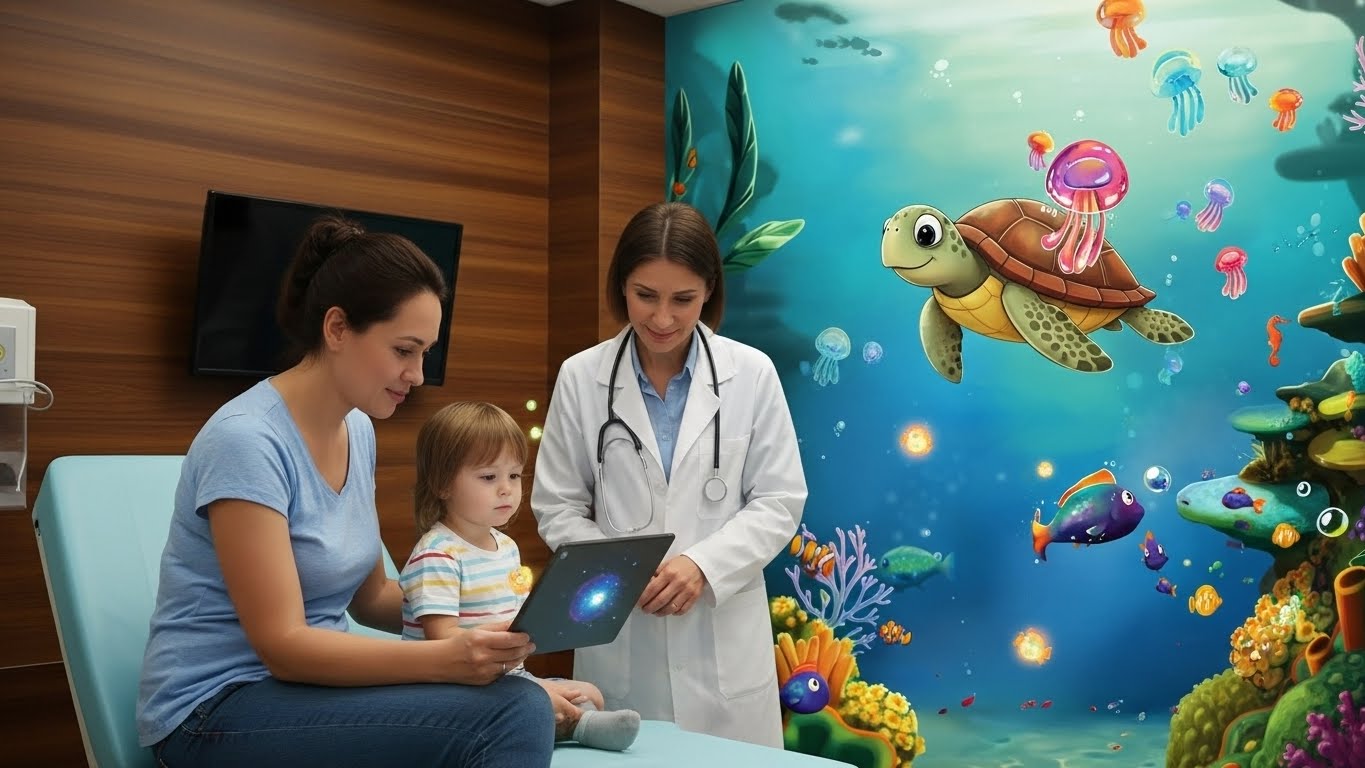
Cosmos Continuum focuses on this delicate center of care—the moment when a child is most vulnerable and most in need of comfort. Using Augmented Reality (AR), Cosmos Continuum brings gentle, interactive moments into the room—not through headsets or projections, but through a familiar phone or tablet. A child lifts the device, and the wall around them comes alive in soft, surprising ways that draw their attention toward curiosity instead of fear. With their attention anchored in something engaging and safe, the rest of the experience can begin to soften. Calm becomes possible. A wall becomes a place to look rather than a place to dread. A breath becomes a rhythm instead of a struggle. The room becomes a little lighter for everyone in it. The AR experience is quiet. The impact is human. And the benefit is shared by child, parent, and clinician alike. This is innovation expressed as compassion—technology becoming compassion in action.
Reimagining Patient Experience From the Inside Out
If we want to improve Patient Experience in a lasting way, we must broaden the conversation. PX cannot be defined only by what happens before and after care. It must also include what a child feels during care. This is where the emotional heart of the visit lives—where fear can escalate or ease, where cooperation can falter or flourish, and where the smallest moment of calm can change the entire trajectory of the experience.
Cosmos Continuum is built for that moment. The moment that matters most.
Learn More
👉 Discover why AR makes Cosmos uniquely suited for hospitals,
clinics, and therapy spaces. Visit
our practitioner page.